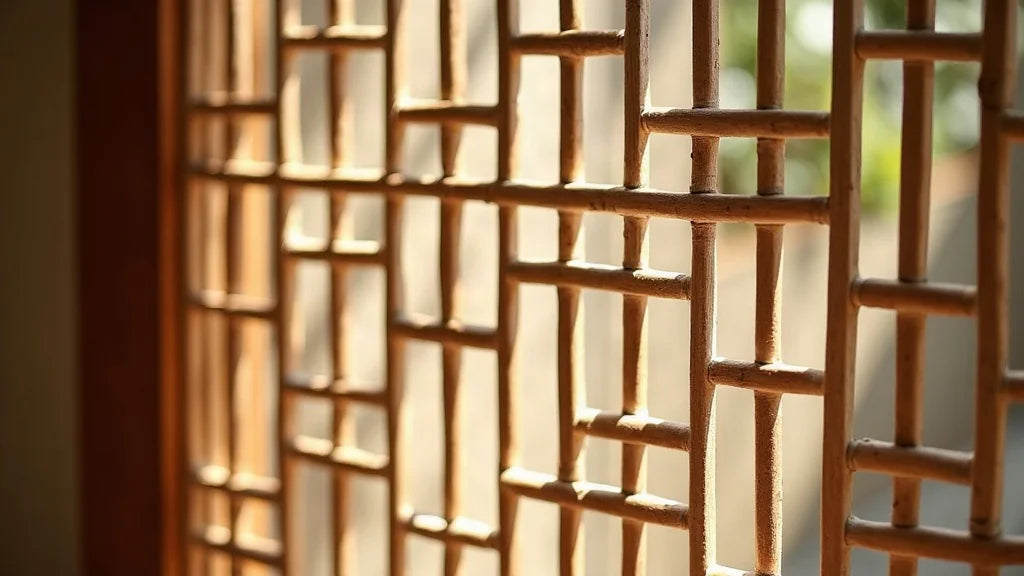
The first kumiko panel I ever touched was in a rented machiya in Kyoto, set above a sliding door where nobody looks. I only noticed it at four in the afternoon, when the sun dropped low enough to throw its pattern across the wall in thin grey lines. Kumiko is a Japanese woodworking technique in which hundreds of thin wood strips are cut, grooved and slotted together into geometric lattice patterns held only by friction: no nails, no screws, no glue. It developed around the year 600, alongside shoji screens and transom panels, and it is still used today in doors, room dividers and lamps. What makes it worth knowing about as a decorator is not just the joinery. A kumiko lattice filters light into fine, repeating shadow lines, which is exactly the diffuse, quiet brightness a Japanese-inspired room lives on.
Key points
- Kumiko joins thin wood strips by precisely cut grooves and friction alone, with no nails, screws or glue.
- A base grid called jigumi carries the pattern, and the decorative pieces are fitted into it afterwards.
- Patterns like asa-no-ha (hemp leaf) or kakutsunagi carry their own meanings, from resilience to continuity.
- Its real decorative value is optical: a lattice breaks light into soft, repeating lines instead of glare.
What is kumiko? Japan's nail-free wood lattice
Before you decide whether kumiko belongs in your home, it helps to know the words that separate it from shoji, ranma and other lattice work. The terminology matters because each piece has a different place, a different purpose. Understanding the basic structure also helps you spot the difference between a kumiko lattice and a simple grid when you are shopping.
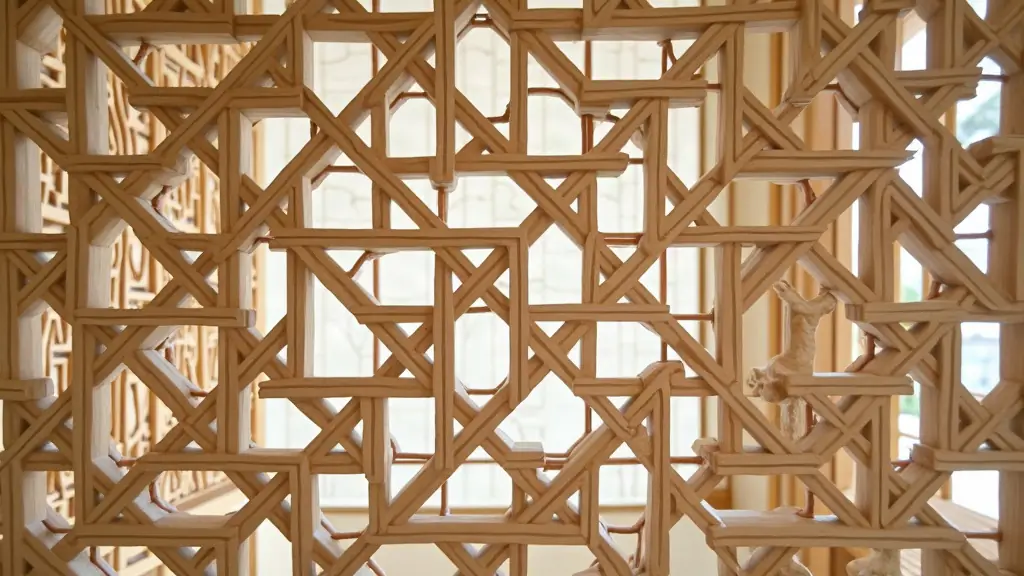
Kumiko and kumiko-zaiku: the words behind the craft
The word kumiko means the small pieces themselves, the strips that make up the lattice. The craft as a whole is called kumiko-zaiku, the work of assembling those pieces. The person who does it is a tategu craftsman, a specialist in fittings: sliding doors, screens, panels, the movable architecture of a Japanese house.
When you shop, a seller who says "kumiko" is talking about the lattice. A seller who says "shoji" is talking about the whole sliding panel, frame and paper included.
How kumiko differs from a shoji screen or a ranma panel
A shoji screen is a sliding door of translucent paper stretched over a wooden frame. The frame's grid may be plain and rectangular, or it may be a kumiko lattice. Kumiko is the decorative geometry inside the opening, not the opening itself.
A ranma transom panel sits above head height, in the gap between the top of a sliding door and the ceiling. Ranma are purely for light and air, not for sliding or handling.
Where you actually meet kumiko lattice in a home
In Japan you meet it in sliding interior doors, ranma panels above them, free-standing room dividers, and lampshades. The first three are architecture. The fourth is the one you can bring home without renovating anything.
A lamp is where this visual vocabulary becomes portable. The Japanese Shoji Lamp is the one I hand to readers first, because it gives you the wood grid and the paper glow in a single object you can set on a side table tonight.

How a kumiko lattice is built without nails or glue
The craft is logical and rhythmic, once you know the order. The foundation comes first, then the decoration fills the spaces it leaves. Seeing how it works gives you a clearer sense of why the wood matters so much, and why precision runs to a fraction of a millimetre.
The jigumi frame: the grid that carries the pattern
The jigumi base grid is the skeleton. Strips run vertically and horizontally, each notched halfway through at every crossing, so two strips interlock flush at the joint. Everything decorative happens inside those openings. A square jigumi gives you square-family patterns. A triangular jigumi, built on strips crossing at 60 degrees, gives you the hemp-leaf family.
Hand planes, jigs and tolerances under a millimetre
The strips are finished with a kanna hand plane, a pull-stroke plane whose blade is set by tapping the body rather than turning a screw. A good craftsman takes shavings thin enough to read through. The angled cuts are made against jigs: small wooden guides for one specific pattern. Tolerances run to a tenth of a millimetre.
Hinoki, sugi and the woods a kumiko panel asks for
The wood has to behave. A strip two millimetres wide with a wandering grain will snap during assembly or bow later.
Hinoki cypress is the classic choice: straight-grained, dimensionally stable, pale blond. Sugi cedar is lighter and softer, with warmer reddish tones and more visible grain lines. Spruce appears in plainer work. Darker woods like walnut show up in contemporary panels as accent pieces against a pale grid.
Pale woods matter for one practical reason. A kumiko panel is mostly shadow, so the strips themselves need to stay bright enough to read as lines rather than dissolving into a dark mesh.
Why light looks different through a wood lattice panel
This is where the lattice stops being craft and becomes mood. The way light passes through a wooden grid, filtered and scattered, creates a glow that a bare bulb cannot match. How you position the lamp, and what surrounds it, makes all the difference to whether the pattern appears as pattern or dissolves.
Lattice plus washi paper: how the glare disappears
Traditional panels use two filters at once. The lattice breaks the light geometrically. Then washi paper, a fibrous Japanese paper made from long plant fibres, scatters what passes through. The effect is glow rather than glare. You cannot see the bulb. You see a lit surface, with the lattice reading as a darker drawing laid over it.
The shadow lines a kumiko pattern draws on a wall
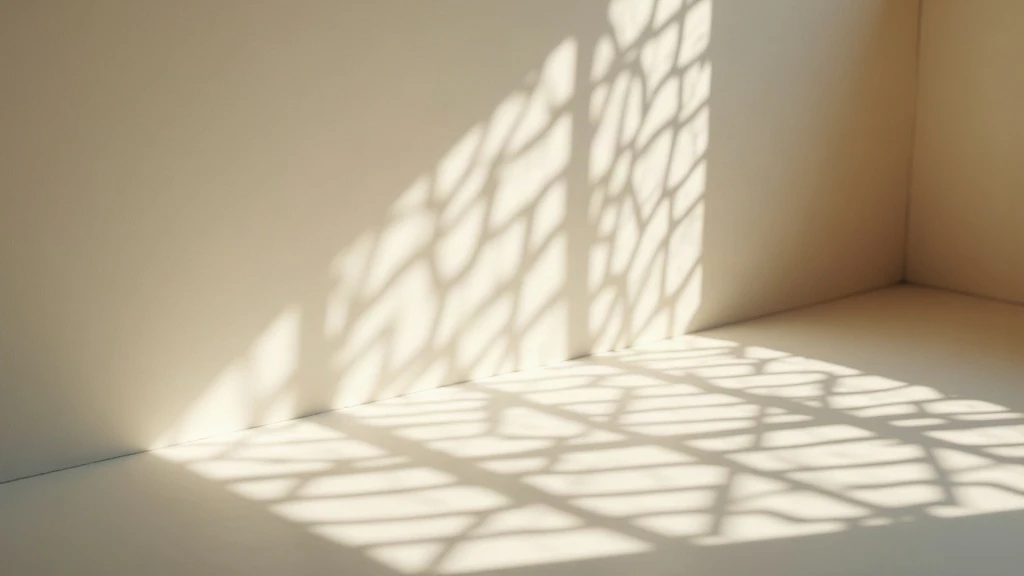
Most people buy a lattice lamp for the object. They keep it for the shadows. With a low-output warm bulb inside, the pattern projects outward onto whatever is nearby, stretched and softened by distance.
The Kumiko Lamp is the one I keep in my own reading corner, because the lattice there is not decoration applied to a shade; it is the structure of the lamp, so the pattern and the light are the same thing.

Placing a lattice light so the pattern stays readable
Three placement rules: keep it low (floor level or a low table), put a pale surface within about a metre where the shadow can land, and avoid backlighting it. A lattice lamp in front of a bright window loses its pattern entirely. Give it empty space on at least one side; the lattice pattern needs ma, the deliberate interval.
Asa-no-ha and other kumiko patterns, and what they mean
Each pattern tells a story, and each one carries its own visual weight. Some are busy and catch the eye immediately; others recede and let the room breathe. Knowing the range helps you choose a lattice that fits the quiet you are after.
The asa-no-ha hemp leaf pattern and its idea of growth
The asa-no-ha hemp leaf pattern is the one everyone recognises: six-pointed stars radiating from a triangular grid. Hemp grows fast and straight, so the motif came to stand for healthy growth and resilience. Visually it is busy, with more line per square inch, which is why it so often appears in a small ranma panel rather than across a whole wall.
Kakutsunagi, goma and the quieter geometric grids
Kakutsunagi means linked squares, read as continuity and things carrying on without break. Goma is simpler still, a compact repeated cell named for sesame seeds. Masu-tsunagi links square measuring boxes, nested one inside the next.
Choosing a lattice pattern for a calm room
Density is the decision. The denser the pattern, the more the eye goes to it and stays. In a small room that reads as pressure, not detail. Dense patterns work in small doses, simple grids in large ones. If you want the lattice to disappear into the room rather than lead it, a plain or lightly linked grid does more for you.
Where kumiko lattice fits in a small, low-furniture room
The lattice was born in rooms where people sit low to the ground, and it still looks best when you do. If you live in a small space or prefer to keep your furniture close to the floor, a kumiko lamp or screen will read at its strongest. The challenge is giving it the right anchor and the right surfaces around it.
Kumiko lattice at floor level, where the eye sits
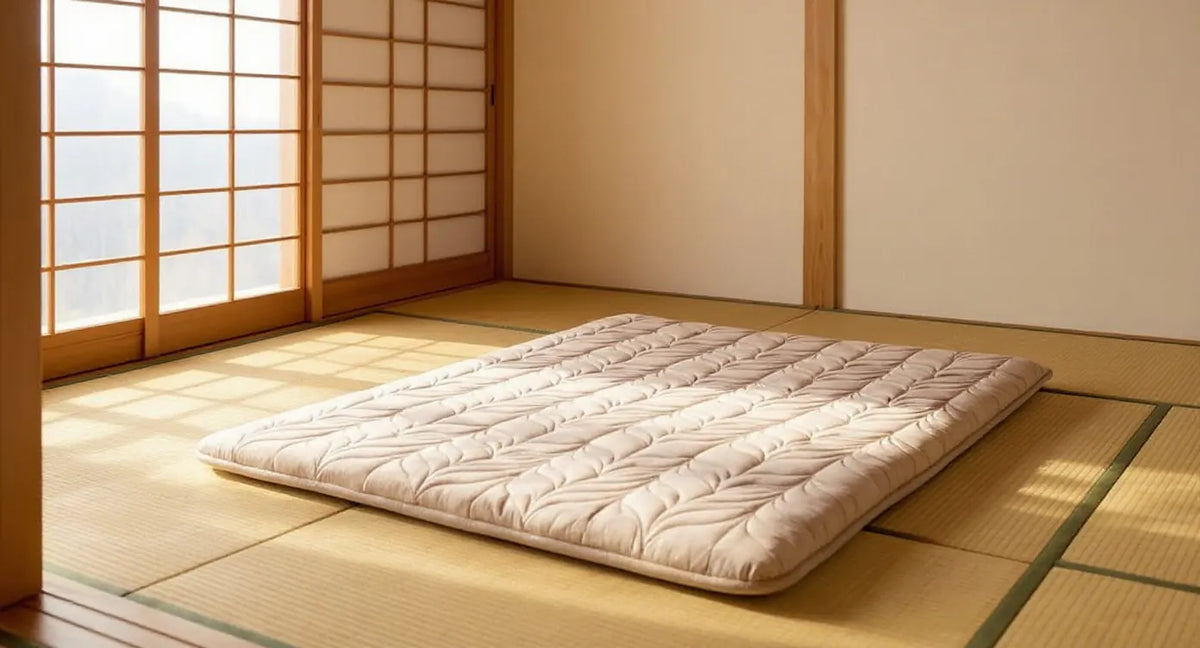
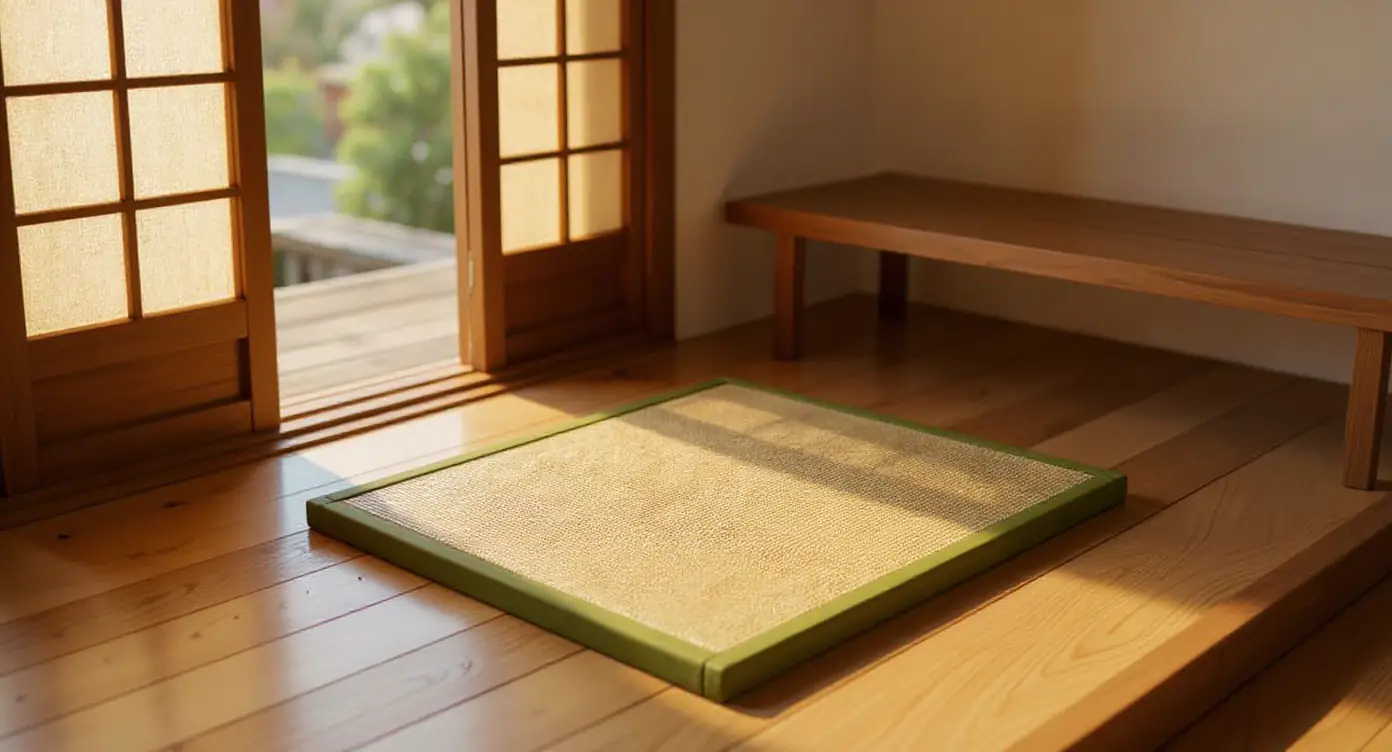
Low seating is what makes the lattice look work. Drop the eye to around 40 centimetres off the floor and light passes across you rather than over you, and shadows stretch longer. The floor is the first anchor. I use a Japanese Floor Mat as the base of that scene, because the woven igusa straw has a faint directional sheen that catches raking light, and a lattice lamp sitting right on it reads beautifully from floor height.

Dividing a studio with a lattice screen instead of a wall
A wooden lattice screen is the best answer for a studio apartment, because it marks a boundary without taking the light. Set one between a bed and a desk and you get two zones that still share the same daylight. Place it perpendicular to your main window, not across it, so the pattern catches side light and casts into the room instead of being flattened.
What the lattice look needs around it: wood, paper, bare floor
Keep the palette grounded: pale wood, off-white paper, straw, unglazed ceramic, linen, one dark accent at most. Leave floor visible. The lattice is already a complex surface. Grooved lattice collects dust in every channel; dust yours with a dry, soft paintbrush working along the grooves, perhaps once a month.
FAQ
These are the technical and practical questions that come up in conversation and email. If you are wondering whether kumiko can be repaired, or how long a panel takes to make, or whether you can try it yourself at home, you will find those answers here.
Is kumiko really made without any nails or glue?
Yes, the lattice itself holds together by friction, with grooves cut so the pieces wedge against each other. Some makers use a trace of adhesive at outer frame joints or to fix paper, and contemporary workshops vary. The structural pattern, though, is a friction fit by definition.
What wood is used for kumiko?
Hinoki cypress is the traditional favourite for its straight grain, stability and pale colour. Sugi cedar and spruce are also common, and darker woods appear in modern panels as contrast pieces. The requirement is always the same: grain straight enough to survive being milled into very thin strips.
Is kumiko the same thing as shoji?
No. Shoji is the sliding paper-and-wood panel; kumiko is the lattice work that can fill its frame. A shoji screen may have a plain grid or an elaborate kumiko pattern, and kumiko also appears in transom panels, dividers and lampshades that are not shoji at all.
How long does one kumiko panel take to make?
It depends entirely on size and pattern density. A small, simple panel is a project of hours; a large dense pattern with hundreds of components runs into days or longer. Precision cutting, not assembly, takes most of the time.
Can a beginner try kumiko at home?
Yes, starting small. Beginner kits with pre-milled strips and a cutting jig exist precisely for this, and a single coaster-sized asa-no-ha unit teaches you more about the geometry than any amount of reading. If the lattice look is what drew you here, the easiest way in is light rather than architecture. You will find the lattice-and-paper pieces I use most in the Japanese Lantern collection, grouped by size so you can match one to the corner you have in mind.
Why are kumiko panels so expensive?
Is a lattice-pattern lamp "authentic" kumiko?
Does kumiko work in a Western-style room?
Can a kumiko panel be repaired?
Explore the Japanese Lantern collection
In the Japanese Lantern collection you'll find paper and wood-frame lights whose lattice grids echo kumiko work, each listed with its dimensions and bulb fitting so you can check it against your room first.
Browse the collection →