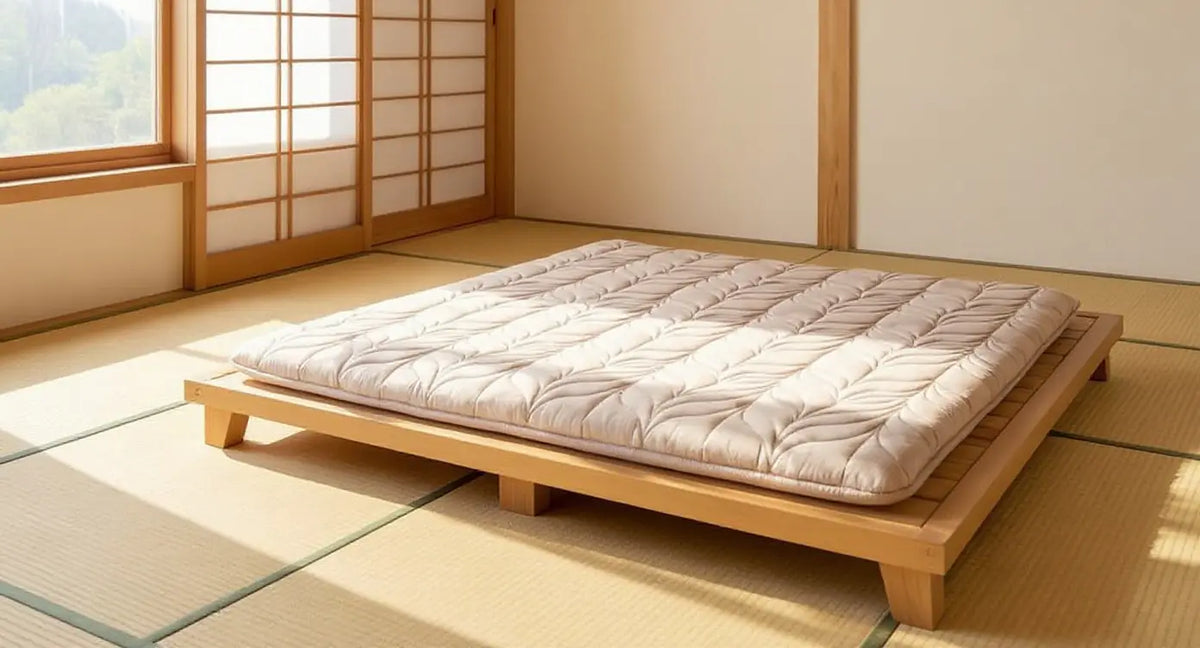
Late afternoon, a tatami floor holds the light differently than wood. The straw absorbs it, the room dims by a shade, and the whole space slows down. That is a washitsu doing its work.
A washitsu is a Japanese-style room built around a simple idea: the floor and the space do the heavy lifting, not bulky furniture. In many homes in Japan, the washitsu is the calm room with Japanese tatami flooring, sliding panels, and a layout that can switch roles fast. It can be a sitting room for tea, a guest room, a quiet reading space, or a sleeping space when a Japanese futon is laid out at night.
In English, people often say "tatami room," and that is close, but not complete. A washitsu is not just tatami. It is also the way light is softened, how privacy is created without heavy walls, and how storage stays discreet so the room feels open even when it is used every day.
Below you will find what makes a washitsu feel authentic, how tatami sizing and layouts really work, what shōji and fusuma do differently, and how to build a washitsu-inspired space in a modern home with clean, believable results.
Key points
- A washitsu is defined by tatami geometry, soft light, sliding separation, and low furniture.
- Tatami sizes vary by region, so measure your room before choosing a format.
- Shōji panels diffuse daylight; fusuma panels are opaque and create privacy.
- A tokonoma alcove gives the room one focal point instead of scattered decor.
- Most washitsu mistakes are fixed by removing objects, not adding them.
Washitsu Meaning and the “Tatami Room” Idea
The word washitsu literally refers to a Japanese-style room. What defines it is not decoration. It is structure and function. A washitsu is planned to be used close to the floor, to stay flexible, and to feel calm even with daily life happening inside it.
Tatami defines the room. Tatami mats are traditionally rectangular with a 2:1 proportion, and a room is often described by how many tatami mats fit inside it. This is where room names like "4.5-jō" and "6-jō" come from. That room count is useful for understanding the intended scale of the space, but the exact floor area depends on the regional tatami standard used.
Sliding panels keep the room adaptable. Instead of fixed, hinged doors and permanent interior walls, a washitsu often uses sliding panels. Some are translucent and soften daylight. Others are opaque and provide privacy. This is the reason a washitsu can feel open during the day and private at night without changing the architecture.
Low living keeps the room open. Floor cushions, low tables, and low chairs are easy to move, so the room can switch roles. The space looks "right" when the center stays clear, the edges remain clean, and storage is tucked away rather than displayed.
Outside Japan, a washitsu is often adapted rather than rebuilt. A full room of tatami may become a tatami zone. Built-in sliding panels may become shōji-style dividers. The goal is the same: soft light, clear geometry, low-living comfort, and a calm focal point that does not turn into clutter.
21 Washitsu Elements That Create an Authentic Japanese Room
Some washitsu features are architectural, like a built-in closet or alcove. Others are practical, like seating and lighting. A space can still read as washitsu without every traditional detail, as long as the core signals stay consistent: tatami geometry, soft light, sliding separation, low furniture, and controlled visual noise.
| Element | Japanese | What it does | Modern-friendly approach |
|---|---|---|---|
| Tatami mats | 畳 (たたみ) | Defines the floor, comfort, and room proportions | Full tatami mats, modular tatami tiles, or a tatami platform |
| Tatami edge | 畳縁 (たたみべり) | Border finish, durability, visual rhythm | Neutral edge style, consistent across the zone |
| Shoji panels | 障子 (しょうじ) | Diffuses daylight for a softer room | Shoji-style screens or interior shoji panels |
| Fusuma panels | 襖 (ふすま) | Opaque sliding panels for privacy and storage | Sliding panels, discreet dividers, or clean closet fronts |
| Tokonoma alcove | 床の間 (とこのま) | Quiet focal point for seasonal display | A niche shelf or dedicated display corner |
| Oshiire closet | 押入れ (おしいれ) | Deep storage for futon and bedding | Closed storage sized for bedding and cushions |
| Zabuton cushions | 座布団 (ざぶとん) | Comfortable floor seating | Thick linen or cotton floor cushions |
| Zaisu chairs | 座椅子 (ざいす) | Back support while staying low | Low back floor chairs with clean lines |
| Low table | 座卓 (ざたく) / 茶ぶ台 (ちゃぶだい) | Tea, meals, and work at low height | Solid low table with wide protective pads |
| Futon | 布団 (ふとん) | Sleeping system that stores away during the day | Foldable mattress and breathable storage |
| Paper shade lighting | 和紙 (わし) texture | Soft light, low glare, warm atmosphere | Paper lamps and warm bulbs with gentle diffusion |
| Natural wood tones | 木 (き) | Warmth and balance with straw and paper | Light oak, ash, or warm neutral woods |
| Ventilation logic | 空気 (くうき) | Keeps tatami and fabrics fresh | Airflow planning and humidity control |
| Minimal display | 間 (ま) | Negative space that makes the room feel calm | One focal point, clean surfaces, closed storage |
| Seasonal branch | 季節 (きせつ) | Seasonal marker in the focal display | A single branch in a ceramic vase |
| Calligraphy or art | 掛物 (かけもの) style | Quiet visual anchor | One piece with space around it |
| Threshold habit | - | Keeps tatami clean and consistent | Clear boundary between shoes and tatami |
| Hidden cables | - | Removes modern visual noise | Discreet cable management |
| Balanced proportions | - | Room feels deliberate, not cramped | Keep furniture scaled to tatami zone |
| Quiet palette | - | Lets materials look natural | Off-white, straw, wood, charcoal accents |
| Clean center | - | Makes the room usable for multiple purposes | Open floor space with movable pieces |
| Discreet storage | - | Prevents the room from looking busy | Closed cabinets and minimal visible items |
Tatami Mats: Sizes, Room Counts, Layout Patterns, and Daily Care

Tatami is the part that can make or break a washitsu. The surface texture is visible in every photo, the seams create the room's geometry, and the igusa straw reacts to moisture and heavy point loads. A few fundamentals avoid the most common mistakes.
Tatami sizes are not universal. Several regional standards exist, and the same "6-jō" room can be physically larger or smaller depending on the tatami standard used. Start with real measurements in centimeters, then choose the tatami format, then the layout. Treat room counts as a guide to scale, not as a fixed square meter value.
Common tatami standards are often described with approximate dimensions. A Kyōma mat is commonly cited around 191 by 95.5 cm. Chūkyōma is commonly cited around 182 by 91 cm. Edoma is commonly cited around 176 by 88 cm. Danchi-ma is commonly cited around 170 by 85 cm and is often associated with apartments. Exact sizes vary by maker and building, so real measurement always wins. When I compare tatami mat formats, I write the room dimensions on paper first, in inches and centimeters, before looking at a single product.
That paper sketch is also how I decide between one large mat and several smaller ones. In a small apartment room, a single mat placed as a defined zone usually reads cleaner than a grid of tiles that stops short of the wall.

Layout patterns change how the room feels. Traditional layouts often avoid having four tatami corners meet at one point. When seams are staggered and oriented intentionally, the floor reads calmer. This logic also helps modular tatami zones in modern homes, because it prevents an overly grid-like, rigid look.
Furniture on tatami needs wide contact points. Heavy furniture dents tatami when the legs concentrate weight in small points. Low tables with wide feet, or protective pads under legs, spread the load. Keeping surfaces dry and ventilating regularly helps tatami stay fresh, especially in humid climates.
Everyday care is simple when the room stays consistent. Keep wet items off the surface. Avoid trapping moisture under thick rugs or sealed plastics. Maintain airflow. Clean gently and consistently so the weave stays even. When the tatami looks clean, the entire washitsu reads more authentic.
Can You Lay Tatami Over Carpet or an Existing Floor?
Yes, over most hard floors. Wood, laminate, tile, and concrete all work if the surface is flat, dry, and swept clean before the mats go down. Modular tiles suit rented apartments because nothing is fixed to the floor and the zone can be lifted in an afternoon.
Carpet is the difficult case. I made the mistake of putting a futon on tatami placed directly over a bedroom carpet, and the underside held moisture within a couple of weeks. The pile also let the mats shift underfoot, so the seams opened slightly each time someone walked across. If carpet is your only option, a thin rigid panel under the tatami gives a flat base and keeps air moving better than the pile alone.
Whatever the base, plan for airflow. Lift the mats occasionally, air the room, and avoid sealing the zone under plastic sheeting. Damp trapped underneath is the single fastest way to ruin igusa straw.
Shoji and Fusuma: The Difference Between Soft Light and Privacy

Shōji and fusuma are both sliding panels, but they solve different problems. Understanding this difference prevents mismatched choices that make the room feel like a mix of unrelated parts.
Shōji (障子) is about light. Shōji panels let daylight pass through while softening it. The wooden lattice gives structure, and the translucent washi surface diffuses brightness so the room stays bright without harsh glare. Glow rather than glare. Shōji is a major reason washitsu photos often look calm and evenly lit.
Fusuma (襖) is about privacy and division. Fusuma panels are opaque, and they separate spaces or close storage. Fusuma helps a washitsu shift from open to private, and it allows adjacent rooms to connect or separate depending on the moment. This flexibility is central to how washitsu can host guests, support family life, and still feel calm.
In modern homes outside Japan, built-in panels may not be possible. The function can still be recreated: shōji-style screens diffuse light and create visual calm, while sliding dividers create privacy without adding heavy furniture. Keep lines straight and materials consistent so the dividers feel architectural rather than decorative.
Tokonoma: The Display Alcove That Makes a Washitsu Feel Complete

A tokonoma (床の間) is a recessed alcove traditionally used for display. It is not storage. It is a dedicated focal point designed for a small arrangement that can change with the season. A tokonoma gives the room structure without filling it with objects, which is one reason washitsu can feel refined even when the furniture count is low.
A tokonoma-style display works best when it stays simple and intentional. One primary visual anchor, such as a kakejiku hanging scroll or framed art, pairs with one natural element, such as a branch or flowers, plus one supporting object like a ceramic piece. The most important feature is the empty space around the items. Space is part of the display. Without that breathing room, the corner stops feeling like tokonoma and starts feeling like a shelf.
In a modern apartment, a tokonoma effect can be created with a niche shelf or a dedicated display corner. The materials can remain modern, but the logic stays traditional: one focal point, controlled objects, and a calm background that does not compete for attention.
17 Steps to Build a Washitsu at Home in a Clean, Believable Way

A washitsu-inspired space looks best when decisions follow a clear sequence. The foundation comes first, then comfort, then light, then focal display. This avoids the common pattern where decorative items are added before the room has structure.
1. Choose the calmest area available, ideally away from constant foot traffic.
2. Decide the primary use: sitting only, sitting and tea, guest sleeping, or daily sleeping.
3. Measure the area precisely, including doors, baseboards, and any fixed obstacles.
4. Choose a tatami format that fits the measurements: full mats, modular tiles, or a platform.
5. Plan the seam orientation so the tatami layout looks intentional and calm.
6. Define the boundary if it is a tatami zone inside a Western-style room, so it reads as a deliberate space.
7. Establish a clean threshold habit so the tatami stays visually consistent day to day.
8. Add seating that supports real use: zabuton first, then zaisu if longer sitting is needed.
9. Choose a low table sized to the tatami area so the center does not feel crowded.
10. Protect tatami from dents by distributing weight under furniture legs.
11. Choose a primary light source that is soft and diffused, with minimal glare.
12. Hide cables and modern clutter so the room stays calm in photos and in daily life.
13. Build storage that disappears, especially if bedding or cushions need to be stored.
14. Add sliding separation if needed, prioritizing clean lines and quiet materials.
15. Create a single focal display area using tokonoma logic: one anchor, one natural element, one support.
16. Lock the palette so materials feel natural together: straw, wood, off-white, small charcoal accents.
17. Finalize the room with restraint so the center stays open and the edges stay clean.
Traditional washitsu rooms often include built-in architectural elements, so the steps above may happen through renovation rather than styling. In modern homes, the same sequence still applies, but the choices tend to be modular: a tatami zone, a shōji-style divider, closed storage, and a few low-living pieces that keep the room open.
Washitsu Comfort: Sitting, Sleeping, and Making the Floor Usable

A washitsu works when it supports real use without looking busy. Comfort is not separate from design. Comfort is part of why the room stays calm, because the space does not need extra furniture to compensate.
Floor seating comfort comes from layers. Tatami is softer than hard flooring, but long sitting improves with zabuton cushions and, when needed, zaisu chairs. The goal is to support the back and hips while staying low, so the room keeps its open feel.
Sleeping comfort comes from a system. A Japanese futon mattress works best when it can be stored away cleanly each morning. Storage is not an afterthought in a washitsu. It is part of the room's identity. When bedding is easy to store, the room stays multipurpose without looking like a bedroom all day.
If your washitsu doubles as a guest room, the folding format matters more than thickness. I keep one rolled in a closet and bring it out only when friends stay.

Climate matters. Tatami and natural fabrics respond to moisture. Regular ventilation, clean airflow, and avoiding trapped dampness keep the room feeling fresh. When the floor looks healthy, the entire washitsu reads more authentic and more inviting.
Common Washitsu Mistakes That Make the Room Feel “Off”

A washitsu usually feels wrong for a handful of reasons. Fixing them often means removing things, not adding more.
Too many small decor items. A washitsu relies on negative space, on ma. When surfaces fill up with objects, the room loses clarity. One focal display area is usually enough.
Harsh lighting. Bright overhead light creates glare and sharp shadows. Washitsu lighting feels softer because the light is diffused. Washi paper shades and gentle warm bulbs support that feeling. I once hung a lamp at standard dining height over a low table, and from the floor it sat straight in the eyeline. Lower it, or choose a floor-level source instead.
Visible modern clutter. Cables, plastic storage, and scattered items break the calm impression quickly. Closed storage and clean lines protect the look.
Wrong scale. Oversized furniture makes a washitsu feel cramped. Small pieces, low pieces, and fewer pieces allow the room to behave like a washitsu instead of a regular room with a tatami mat placed inside it.
FAQ
A washitsu is a Japanese-style room defined by tatami geometry, soft light, flexible separation, low-living comfort, and storage that stays quiet. Traditional washitsu rooms use shōji, fusuma, oshiire storage, and sometimes a tokonoma alcove. Modern homes can recreate the same logic with a tatami zone, low seating, diffused lighting, and one calm focal point. When the space remains open and materials stay natural, the washitsu reads clearly and works in everyday life.

What does washitsu mean in Japanese?
Washitsu (和室) means a Japanese-style room. It commonly refers to a room with tatami flooring and traditional features such as sliding panels.
What is a Japanese floor covering called?
The traditional floor covering used in a washitsu is called tatami (畳).
What is in a washitsu?
A washitsu commonly includes tatami flooring, sliding panels such as shōji and fusuma, low seating like zabuton, and discreet storage. Some washitsu rooms also include a tokonoma display alcove.
What is the purpose of a tatami room?
A tatami room is designed for flexible use. It can support sitting, tea, receiving guests, and sleeping with a futon laid out at night, while staying open and calm during the day.
What is the difference between shoji and fusuma?
Shōji are translucent panels that diffuse daylight. Fusuma are opaque sliding panels used for privacy and room division.
Explore the Tatami Mat collection
If you are ready to start with the floor, take a slow look through our Tatami Mat collection and find the format that fits your room.
Browse the collection →