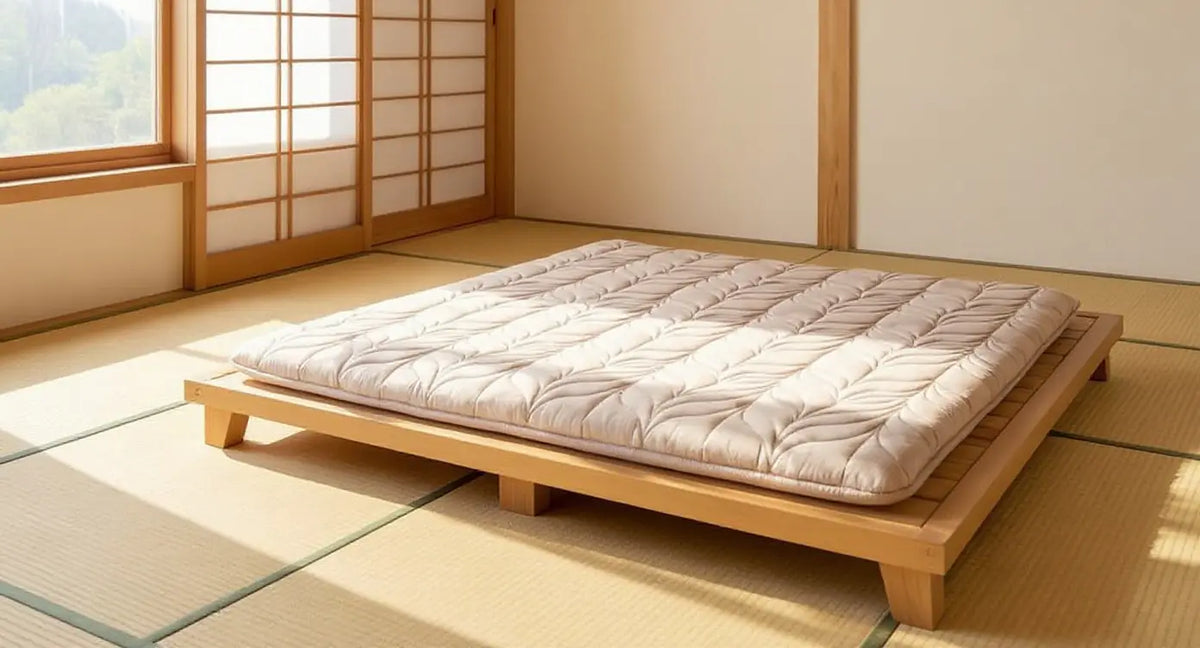
The first night I tried it, I laid a futon on the floor beside my bed frame and left the frame standing, made up, in case I gave up at 2 a.m. I did not give up, but I did keep that frame for another three weeks. That is the honest core of most transitioning from bed to floor sleeping tips: start with the layers, not the mattress. A breathable base first (tatami or a slatted platform), then a futon of about 3 to 4 inches for most adults, then cotton or linen bedding you can wash without ceremony. Sleep on that stack for a few nights before you dismantle anything, and give yourself two to four weeks to adjust to the lower height and the morning fold. The habit that makes the whole thing work is airing: fold or flip the futon each morning so moisture leaves the underside.
In short
- Three layers are enough: breathable base, futon, cotton or linen bedding.
- Most adults land between 3 and 4 inches of futon thickness on tatami, and add loft on hard floors.
- Fold or flip the futon every morning so the underside dries. That is the entire routine.
- Keep the bed frame for two to four weeks, then decide what to do with the reclaimed floor space.
Building a futon stack: base, mattress, bedding
A futon laid straight on a sealed floor traps the air between fabric and surface. Your body warms that air all night. In the morning the underside feels cool and slightly damp. A breathable base solves this by letting the futon breathe from below, which is why the traditional Japanese bedroom starts with the floor and never with the mattress.
Tatami, slatted or roll-up: the base under your futon
Three bases are worth comparing. Tatami is the classic: a firm mat with a woven igusa rush surface, slightly springy, with a faint grassy smell when new. A slatted platform is a low wooden frame with gaps between the boards. A roll-up mat is the lightest option, easy to store, thinner underfoot.
For a bedroom I plan to keep, I choose tatami. A Japanese tatami mat is what I put down first when a reader tells me the room is bare, because the futon, the lamp height and the seating all follow from it.
How many inches of futon do adults need
Traditional Japanese sleeping is done on a shikibuton, the folding cotton mattress. Its futon thickness is what decides comfort, not the price. Below roughly 2.5 inches most adults feel the floor at the hip and shoulder. Above 5 inches the futon gets heavy to fold daily, which quietly kills the routine.
The Japanese futon mat is the one I suggest most often to first-timers, because it folds without a fight and stores upright in a closet, which is what you need during the trial weeks. Check the listed thickness in inches and centimetres against the table above before you order.

Cotton and linen bedding for a futon: sheets, pads, covers
Keep the top layers washable and few. A fitted sheet sized for the futon depth, a light quilted pad if you want a softer surface, and a duvet you can lift and shake out. Cotton and linen bedding works better here than synthetics, since it moves moisture instead of holding it against the futon. Total height once assembled sits around 6 to 8 inches. Low enough to change how the room reads, high enough to keep dust off the sheets.

A four-week plan for transitioning from bed to floor sleeping
Do not remove the bed on day one. The point of a plan is that you can stop halfway and lose nothing.

Week 1 to 2: trial nights on the futon
Lay the base and futon on any free stretch of floor, ideally where the bed will eventually sit. Sleep there three or four nights the first week, then five or six the second. Expect some soreness at the hips and shoulders, and a slower, stiffer rise in the morning. Most of it settles as you learn to change position more often. If it does not settle after two weeks, the answer is usually more thickness or a different pillow, not more willpower.
Week 3: move the whole sleep setup down to the futon
Now bring everything to floor level. Bedding, phone, book, glass of water, a small light. Pillows matter more than people expect: lying lower changes the angle of your neck, and a pillow that suited a tall mattress often feels too high on a futon. Side sleepers generally keep a medium pillow. Back sleepers usually drop one loft level. Give this a full week before you judge.
Week 4: keep the bed frame or commit to floor sleeping
By now you know. Either you sell or store the frame and gain the floor, or you go back to it having learned what your body prefers. Both outcomes are fine. If you keep the floor setup, measure the empty wall where the bed stood before you buy anything to fill it, and wait a week. Rooms feel different once the highest silhouette is gone.
The morning airing routine that keeps a futon dry
Two minutes each morning. That is the whole cost of floor sleeping, and skipping it is the one habit that ruins futons.
Fold, flip or hang the futon: three levels of effort
The minimum is to flip the futon over so the underside faces up, then pull the bedding back. Better is to fold it in thirds and stand it against a wall, which exposes the base as well. Best, on a dry day, is to drape it over a rail or a chair back for an hour. Once a week, leave it folded and standing while you air the room. Every few months, rotate it head to foot so it compresses evenly.
Signs of moisture under the futon
Lift a corner each morning and touch the floor underneath. Cool is normal. Damp is not. Other signals: a faint musty smell, dark patches on the base, or bedding that never quite feels dry at the foot end. Condensation and mildew build up long before anything is visible, so trust your hand before your eyes.
Airing a futon in a small apartment without a balcony
No balcony is not a problem. Fold the futon, stand it in the room, open a window for ten minutes and let the air move. A fan pointed at the standing futon for twenty minutes does more than a closed room with sun through glass. In humid months, air more often and consider a slatted base for the extra gap. Long direct sun can fade covers, so short sessions are kinder.

Designing the room around a floor-level futon
Once the futon is the lowest thing in the room, everything else starts to look too tall. I went through this slowly, moving one piece at a time until the proportions settled. Here is what I would change first, and where the futon should live between two nights of sleep.
Sight lines, lamps and storage around a floor futon
The first thing you notice is the ceiling. With the tallest object gone, the walls read taller and the room feels wider than the floor plan says. Keep the rest of the furniture in the same register: low furniture, open shelves, nothing at eye level near the sleeping corner. Move your lamp down as well. A lamp made for a nightstand sits too high beside a futon and puts the bulb in your line of sight. A paper-shaded floor lamp gives glow rather than glare.
Where the futon goes during the day
Folded in thirds, a futon becomes a low block roughly the size of a large ottoman. Three homes for it work well: a closet shelf, a corner with a cloth thrown over it, or a low bench that doubles as seating. The floor it leaves behind is the real gain, and I would rather leave it empty than fill it. If you want the room usable during the day, a pair of zabuton, the flat Japanese floor cushions, around a low table gives you somewhere to sit without raising the silhouette of the room.
Futon mistakes people make in the first month on the floor
Almost every problem I hear about comes down to three things, and I have made all of them myself. None of them means floor sleeping was a bad idea. They just need fixing before you decide anything about your bed frame.
Futon directly on carpet or concrete
Carpet holds humidity and dust and gives the futon nowhere to breathe. I made this mistake early and the underside was damp within a fortnight. Put a tatami or slatted platform between them. Concrete is worse in winter, since it pulls heat and encourages condensation at the coldest spot.
A futon too thin, too thick, or the wrong pillow
Thin futons feel fine for a week and then the hip complains. Very thick ones stop getting folded, which leads straight to the moisture problem. If you wake with a sore shoulder as a side sleeper, add thickness or a quilted pad before changing anything else. If you wake with a stiff neck, the pillow is almost always the cause.
Skipping the futon airing for a week
One missed morning is nothing. Seven in a row, in a humid month, is how a futon starts to smell. If it happens, fold it, stand it up, run air across both faces for a full day, and check the base. Floor sleeping does not suit every situation, either. If getting up from the ground is difficult, or your ground floor is cold and uninsulated, a low platform bed gives you most of the same proportions with less of the compromise.
FAQ
These are the questions that land in my inbox most often, almost always in the first fortnight of the trial. Thickness, comfort and airing come up again and again, so here are the short answers.
Is a futon on the floor comfortable enough for a side sleeper?
For most side sleepers, yes, once the thickness is right. Aim for the upper end, around 4 inches, so the shoulder and hip sink slightly instead of pressing into a firm surface. A thin quilted pad on top adds surface softness without making the futon hard to fold.
How thick should a Japanese futon be for an adult?
Roughly 3 to 4 inches over tatami or a slatted platform. On bare hardwood, tile or concrete, go to 4 inches or more and add a base underneath. Much thinner and you feel the floor at pressure points, much thicker and daily folding becomes a chore you will skip.
Can I put a futon directly on carpet or concrete?
I would not. Both trap moisture against the underside, and concrete adds a cold surface that encourages condensation. Put a tatami mat, a slatted platform or at minimum a breathable roll-up mat in between, and keep checking the floor with your hand each morning.
How long does it take to get used to sleeping on the floor?
Two to four weeks for most people. The first nights bring some hip and shoulder soreness and a slower morning rise. Keep your bed frame until the end of that window so the decision stays reversible.
How often should I air and fold my futon?
Every morning, without exception. Flipping it over takes seconds, folding it in thirds and standing it against a wall takes a minute. Once a week, leave it folded and standing while you air the room, and rotate it head to foot every few months.
If you are ready to build the stack, the Japanese futon mattress collection lists thickness, materials and dimensions in inches and centimetres so you can compare before you decide. Worldwide shipping is free, and returns are open for 30 days.
Explore the Japanese Futon Mattress collection
Browse futon mattresses by thickness, size and cover material to build your floor sleeping layers.
Browse the collection →