A folding fan looks weightless on the wall, and that is exactly the trap: people reach for a pin because the object seems too light to need thinking about. One pinhole through a painted leaf never closes. The short answer to how to display a Japanese hand fan on a wall: support it from behind or at its ribs, using a small bamboo or acrylic wall bracket, a folded-fan rack, or removable adhesive strips placed on the outer guard sticks, never a pin, nail or tape through the paper leaf itself. Hang it on a plain matte wall at around 57 to 62 inches (145 to 157 cm) to the centre of the fan, on a stretch that gets no direct sunlight, since UV fades hand-painted pigments and makes paper brittle within a season or two. Then leave 12 to 20 inches (30 to 50 cm) of empty wall on every side, the way a scroll breathes inside an alcove.
In short
- Support the fan at its ribs or guard sticks, and never pierce, pin or tape the paper leaf.
- Centre the fan around 57 to 62 inches (145 to 157 cm) from the floor, or at seated eye level above low furniture.
- Keep it off any wall that catches direct sun, because hand-painted paper fades and yellows fast.
- Leave a wide margin of bare wall around the fan so the empty space becomes part of the display.
Sensu or uchiwa: which Japanese fan hangs best?
Your fixing method depends on the fan's skeleton. Measure and identify it before you touch the wall.
The folding sensu and its arc of bamboo ribs
A sensu is the folding fan. Thin bamboo ribs pivot on a single rivet, and the paper leaf is pleated across them. Open it and the ribs spread through an arc of about 150 to 180 degrees, which is why a folding fan reads as a half-circle on a wall.
A common household sensu measures roughly 8 to 10 inches (20 to 25 cm) along the rib and spans about 15 to 19 inches (38 to 48 cm) when fully open. Decorative wall fans go much wider. Measure the open span first, then check your wall has that width plus the empty margins on both sides. A plain folding Japanese hand fan is the piece I reach for first when someone wants to see how the rib structure works before committing to a large format; the two outer sticks are stiff enough to carry the whole weight on a bracket.

The flat uchiwa and its single handle
An uchiwa is the flat paddle fan. It does not fold. A single length of bamboo is split into thin ribs, and paper is pasted over the frame. It ends in one solid handle, which is a gift for display: that handle sits in a bracket, a small hook, or the notch of a stand without any contact with the paper.
Reading your fan's leaf: paper, silk or printed cotton
Fixing a Japanese hand fan without piercing the leaf
A paper sensu weighs almost nothing: often 1 to 3 ounces (30 to 85 g). Even a large decorative fan rarely passes 8 ounces (225 g). You are not hanging a mirror. Drilling is unnecessary in almost every case.
Wall brackets and bamboo fan stands
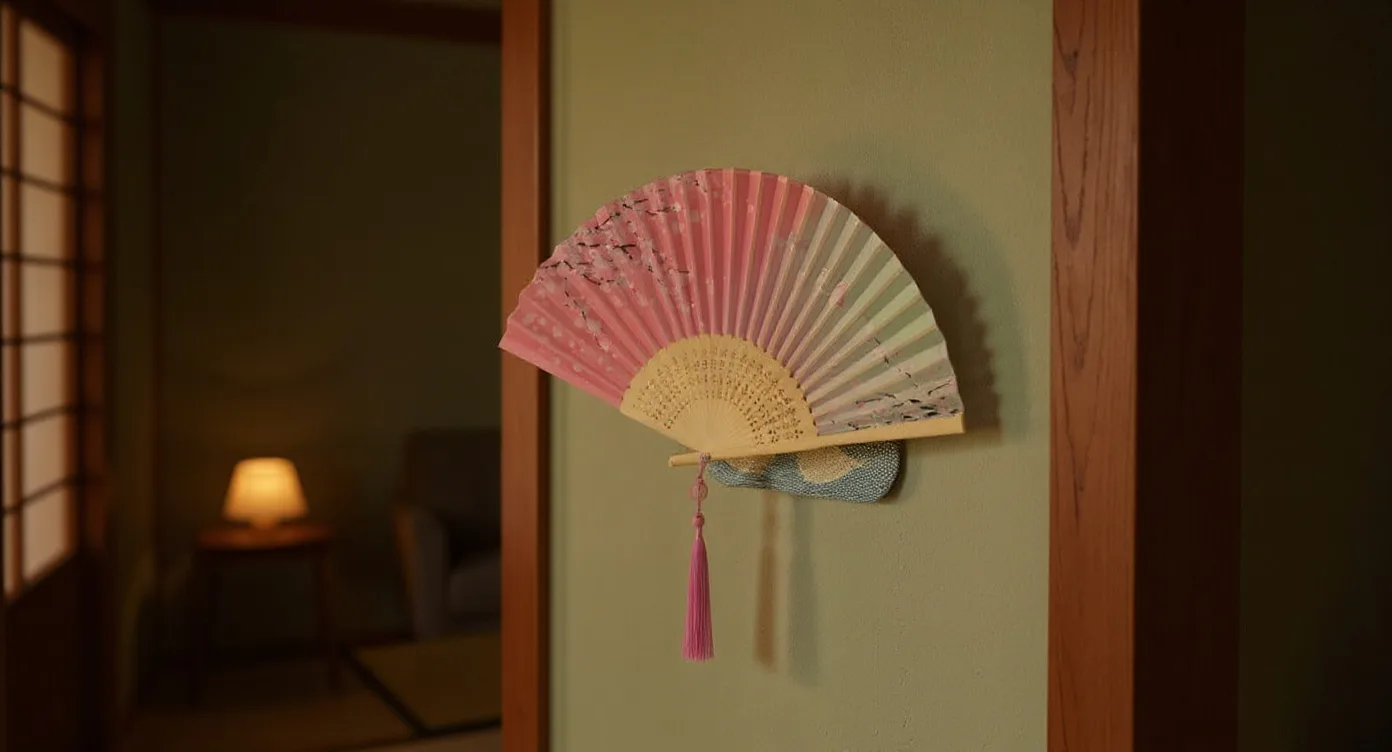
The cleanest solution is a small bracket or fan rack that cradles the fan from below and behind. The ribs rest in the channel, the leaf touches nothing sharp, and you can lift the fan off in one second to dust it or swap it for another season. A tabletop fan display stand does the same job on a shelf or a low console if you would rather not fix anything at all. For a fan wider than 24 inches (60 cm), use two brackets spaced about a third of the span in from each end so the ribs stay level.
Adhesive strips on the fan's guard sticks only
Removable adhesive strips work well, on one condition: they go on the two outer guard sticks, the rigid end ribs, and nowhere else. Never on the pleated leaf. Press each strip for about 30 seconds, then leave the fixing an hour before hanging anything on it. To take it down later, pull the tab slowly straight down along the wall; pulling away from the wall is what lifts paint.
What never to use on a fan: pins, staples, hot glue, tape
A pin through the leaf tears wider every time the paper moves with humidity. Staples rust and stain. Hot glue stiffens the pleats so the fan can never fold again. Packing tape and masking tape leave adhesive that yellows into the fibres and cannot be lifted without taking the surface layer of paper with it.
How to display a Japanese hand fan on a wall at the right height
Height is where most fans go wrong, usually a good six inches too high. I work from a single pencil line and adjust it to the room rather than to the wall. Here is the reference height, and how I shift it for low furniture, corridors and stairwells.
The 57 to 62 inch centre line for a folding fan
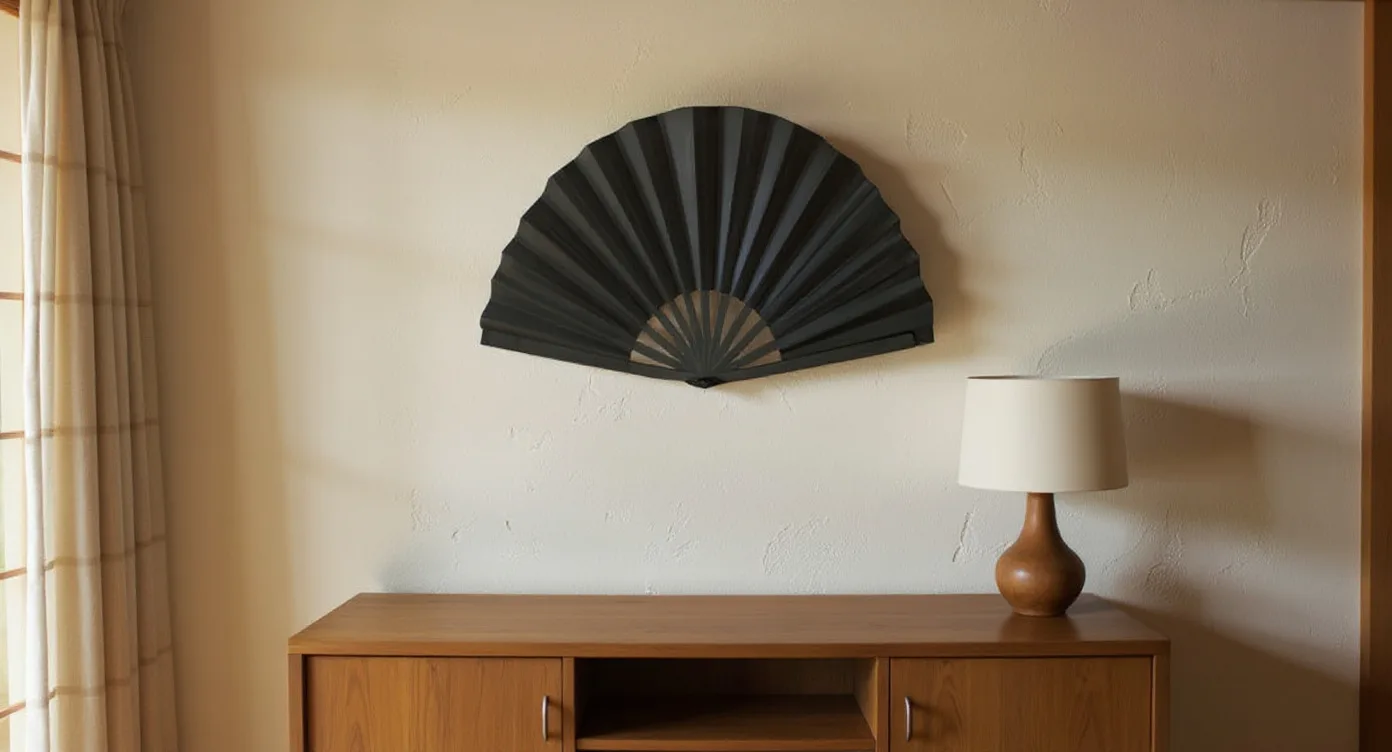
Gallery practice puts the centre of a work at roughly 57 to 60 inches (145 to 152 cm), average standing eye level. For a fan I nudge that to 57 to 62 inches (145 to 157 cm) depending on ceiling height. Mark the line in pencil and check it with a level. The visual centre of an open sensu is not its geometric centre: the mass of the leaf sits high and the pivot low. Centre the middle of the paper arc on your line and let the rivet fall below it.
Lowering the fan above a console, futon or floor seat
A Japanese-leaning room is lived in low. If you sit on a zabuton cushion or at a chabudai low table, drop the centre by 4 to 6 inches (10 to 15 cm). Above a futon or a low console, leave 8 to 10 inches (20 to 25 cm) of wall between the top of the furniture and the bottom edge of the fan, so the two read as one composition. A wide statement piece such as a big Japanese fan is what I would hang above a low sideboard, because its span needs distance to be read and the low furniture gives it that breathing room.

Hanging a fan in a narrow hallway or stairwell
In a corridor under 40 inches (100 cm) wide you cannot step back, so choose a smaller fan and raise the centre to around 62 inches (157 cm). On a stairwell wall, align the centre with the eye level of someone standing three steps below it, not with the floor.
Hand-brushed washi paper is the most fragile and the most beautiful under low light. Silk leaves are heavier and can sag if the fan is left open for months without support along the lower edge. Printed cotton and synthetic fans are tougher, tolerate a little more light, and suit a hallway that catches morning sun.
Where light and humidity harm a paper fan
The wall you choose matters more than the bracket you buy. Sunlight, dry heat and steam each damage a fan in their own way, and none of it can be undone afterwards. Let me go through the three walls I always rule out, and the backdrop I look for instead.
Why direct sun bleaches a hand-painted washi fan
UV light breaks down pigments, and the plant-based inks used on hand-painted fans are among the first to go. Reds turn dusty pink, indigo drifts grey, and the paper yellows as the starch paste ages. A fan facing a bright window can visibly shift within one or two summers. There is no repair; there is only prevention.
Keeping the fan away from radiators, bathrooms and steam
Paper moves with moisture. A fan above a radiator dries, shrinks and cockles along the pleats. In a bathroom or over a stove, the reverse happens: the leaf absorbs steam, the pleats soften, and old paste can release along the ribs. Keep at least 3 feet (90 cm) between the fan and any heat source, and keep it out of wet rooms entirely.
Choosing a matte, neutral backdrop for a painted fan
Hang the fan on a wall perpendicular to the window rather than opposite it. Indirect light is enough: a glow across the paper, not a spotlight on it. A matte finish in off-white, warm grey, clay or pale plaster lets the brushwork read. Patterned wallpaper competes with the painted leaf and both lose. If you own two or three fans, rotate them by season and rest the others flat in a drawer, folded, out of the light.
Ma: empty wall around your sensu, as in a tokonoma
Once the fan is up, the wall around it becomes part of the piece. I measure that emptiness as carefully as the height, because a fan crowded by frames stops reading as a fan. Below: the margins I keep, what a fan can be paired with, and how to hang two or three together.
How much bare wall to leave around the fan
In a tokonoma, the recessed display alcove of a traditional room, a single hanging scroll is given the whole space to itself. Translate that restraint into measurements: 12 to 20 inches (30 to 50 cm) of empty wall on each side of the fan, at least 12 inches (30 cm) from a room corner, and 16 inches (40 cm) or more from the nearest frame or shelf. This is ma, the negative space, and it is doing as much work as the object.
Pairing a fan with a print or a single object
One companion is enough. A small sumi-e ink drawing, a ceramic vessel on a shelf below, a single stem in a narrow vase. Keep the second object visually lighter than the fan and offset it rather than centring it, the way a scroll in an alcove sits beside, not above, a flower arrangement.
Grouping two or three fans without crowding
Treat a group as one object. Align the fans on a shared centre line or a shared bottom edge, keep the spacing between them identical, around 4 to 8 inches (10 to 20 cm), then apply the full 12 to 20 inch margin around the outside of the whole group. Three fans of the same size read calmly. Three sizes and three palettes read as clutter.
Japanese fan wall display: quick answers
FAQ
These are the questions readers send me most often once the fan is out of its box and they are standing in front of a bare wall. Most of them come down to the same worry: how to hold the thing without damaging it.
How do I hang a Japanese fan without making holes in the wall?
Use removable adhesive strips fixed to the two outer guard sticks, pressed for 30 seconds and left an hour before you hang. A fan weighs so little that one strip per stick is usually enough. Remove them by pulling the tab slowly downward, flat against the wall.
My fan has no string or loop on the back, what now?
Most fans have none, and you should not add one by piercing the leaf. A bracket that cradles the ribs from below, or a rack designed for a folded fan, holds it without any attachment point. For an uchiwa, a small hook under the handle does the job.
Should the fan be displayed open or folded?
Open shows the painting and fills the wall; folded reads as a quiet vertical line and takes very little space. If your fan is silk or an older piece, close it every few months and rest it flat for a while, so the pleats keep their memory and the lower edge does not sag.
How do I dust a paper fan hanging on the wall?
Lift it off its bracket and take it to a table. Brush along the pleats, never across them, with a soft dry brush such as a clean makeup brush. No water, no spray, no damp cloth: moisture lifts pigment and softens the paste along the ribs.
Can I frame a hand fan in a shadow box instead?
Yes, and it protects the fan from dust and handling. Ask for UV-filtering glazing and acid-free backing, and have the fan supported on mounts rather than glued down. Note the trade-off: a shadow box adds depth and a hard rectangle to the wall, which sits less quietly than the bare silhouette of the fan.
If you are choosing a fan for a specific wall, the sizes and paper finishes in our Japanese fan collection are worth a slow look before you measure your margins.
Explore the Japanese Fan collection
Browse our Japanese fans to find a sensu or uchiwa sized for the wall you have in mind, with dimensions and materials listed for each.
Browse the collection →