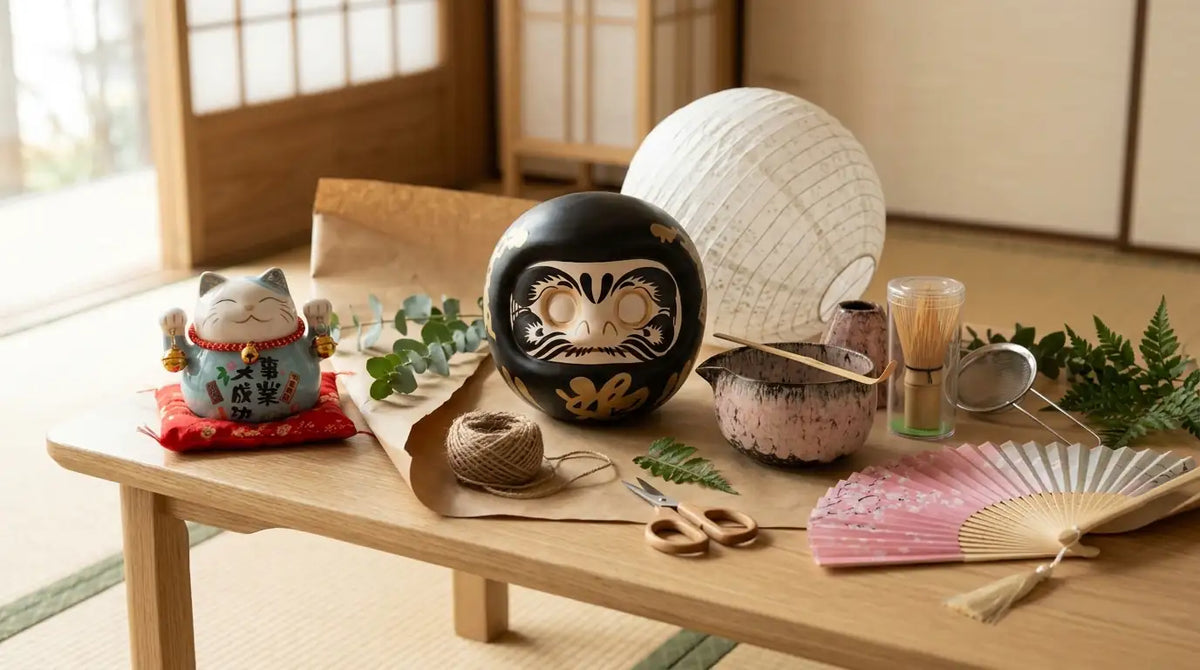
A friend moved into a one-room apartment last spring. I brought a folded cloth with a small hanging lantern inside it, because the ceiling had one bare bulb and nothing else. We hung it before we unpacked the kitchen. The light changed, the room softened, and the gift was over in four minutes. That is the kind of Japanese gift I keep coming back to.
So, what Japanese gift do you give for a home? Give one object the person will touch regularly, and let it be small. A matcha set, a bento box, a pair of bamboo chopsticks, a noren for a doorway. If you want decor instead of a tool, give light or textile before you give furniture, because light and textile fit any room. Save the big pieces, a tatami chair or a grill, for people whose space you have actually seen.
Below are fifteen pieces I give, in the order I usually reach for them. For each one I explain what it is, what it does in a Japanese home, what it is honestly good and bad at, and the occasion it suits. There are also three notes on Japanese gift etiquette, which matters more than the object itself.
I write from use. I have put a futon on carpet too early, hung a lamp too high for floor seating, and given a vase with a mouth too narrow for the flowers the person already owned. Those mistakes shaped this list.
Five things worth knowing before you choose
- Think in three tiers. A small carried object, a mid-range piece for a shelf or doorway, and one larger item for the floor. Most people are happiest receiving the first two.
- The gifts that land every time are the used ones. Tea tools, lunch boxes, chopsticks. They enter a routine, and the routine keeps reminding the person of you.
- In Japan, some gifts carry unwanted meanings. Knives and scissors suggest cutting a tie. Combs are avoided because the sounds in kushi echo suffering and death. Handkerchiefs can read as parting. A clock to an elder can read as a lecture about time.
- Measure first. Doorway width for a noren, ceiling drop for a lantern, table height for a floor chair. A gift that does not fit becomes a storage problem.
- Presentation carries half the gift. A furoshiki cloth, both hands, and a modest word. No ribbon mountain needed.
1. A matcha set turns a quiet morning into a small ritual
Matcha is green tea leaf ground to a fine powder. You do not steep it. You whisk it into hot water until it foams, and you drink the leaf itself. That one difference is why the tools exist. A matcha set gathers them: a wide shallow bowl called a chawan, a bamboo whisk called a chasen, a thin curved scoop called a chashaku, and a rest that holds the whisk tines up as they dry. A Western tea gift is usually a box of leaves and a metal infuser. This is a set of gestures instead.
The bowl is wide because the whisk needs room to move. You sift two scoops of powder, add a little hot water, and whisk fast from the wrist, not the arm. In summer I whisk the same bowl with cold water and pour it over ice. The same tools handle hojicha latte powder or cocoa when someone in the house does not want caffeine. Nothing in the set is single-purpose.

What it costs you is a tray's worth of counter space. Cleaning is water only, no soap, and the whisk goes back on its rest to keep its shape. The honest limit is the whisk itself. Bamboo tines are thin, and after months of daily use some will break. That is normal, and a new chasen is the cheapest part of the set to replace. The bowl and scoop outlast it by years.
As a gift it gives someone a reason to stop moving for three minutes. That reads as attention. You are not saying you should relax, which nobody enjoys hearing. You are handing over the equipment for a short, specific, repeatable act. The set also looks right left out on an open shelf, so it does not get buried in a cupboard like a gadget would.
I give this one as a wedding gift. Two people setting up a first kitchen together usually receive duplicates of everything practical, and nothing that belongs to both of them at once. Tea is made for one person and shared with another. Put the set in a cloth with a small tin of ceremonial-grade powder so they can use it the first morning.
2. Rolling at the table with a Sushi Making Kit
A sushi making kit gives you the tools that make the shaping repeatable: moulds for pressing maki rolls and forms for shaping rice, so the roll holds and cuts cleanly instead of unravelling on the board. A note of honesty first, because it shapes expectations. In Japan, sushi is mostly shop food made by someone who trained for years. What people make at home is simpler: temaki hand rolls assembled at the table, chirashi with toppings scattered over a bowl of rice, inari pockets. A kit belongs to that home tradition, not to the counter at a sushi bar.
The best use is social. Put the rice, the nori sheets, the cucumber batons and the fish or the avocado in the middle of the table and let everyone shape their own. Children take to it immediately, because it is a building task with a reward. Beyond rolls, the moulds press onigiri rice shapes for lunch boxes the next day, which is how mine mostly gets used.

It shortens the learning curve to one evening, which is the real value. Here is the limit nobody mentions: the roll is not the hard part. Rice is. You need short-grain Japanese-style rice, rinsed until the water runs clear, cooked firm, then seasoned with rice vinegar, sugar and salt and cooled while you fan it. Get the rice right and a mould is almost unnecessary. Get the rice wrong and no tool saves the evening. Moulds also give very uniform rolls, which some people love and others find a bit tidy.
As a gift it turns into a night rather than an object, and that is why I keep giving it. The receiver does not just own something, they do something, usually badly the first time and much better the third. Add a bag of short-grain rice, nori and a small bottle of rice vinegar so nothing stops them starting.
This is my Christmas gift when a family is going to be in the same house for several days. It fills an afternoon between the big meals, and everyone eats what they made. It also works as a gift for a couple who cook together and have run out of new things to try.
3. Sitting low in the house, with a Floor Cushion under you
A zabuton is the flat, firm cushion used for sitting on tatami, the thick woven mats of igusa straw that cover the floor of a washitsu, the traditional Japanese room. It is a seat, not a decoration. That is why it is wide, square-ish and only a few fingers thick. A Western throw pillow is soft, deep and designed to be leaned against. Sit on one and you sink until your knees are above your hips. A floor cushion stays firm enough to keep your spine stacked, which is the whole reason floor life works in a Japanese home.
It is the seat at a chabudai, the low table used for eating and working. It is also the spare chair that lives in a closet, stacked three high, and comes out when people arrive. I use one for sitting practice in the morning, one under a child doing homework at the low table, and one on the floor beside a futon while reading. Two cushions stacked raise a short person to the right height at a low table, which is a trick worth knowing.

The appeal is that it adds a seat without adding furniture. No legs, no footprint, nothing to mark a floor, and it hides in a cupboard. Check the listing for whether the cover comes off, because that is what decides how easy it is to keep clean. Two limits to be honest about. There is no back support, so an hour is comfortable and three hours is not. And firm cushions do flatten with use, so expect to plump and rotate them.
It is a gift that invites people to sit down, which is a generous thing to give a household. It also fits a small home where another chair genuinely will not go. A pair reads better than a single, because it suggests company.
I give a pair when a baby arrives. New parents spend months on the floor, and the floor is usually cold and hard. A firm cushion makes that time bearable, and later the same cushion becomes the toddler's seat at the low table. Choose a cover in a muted colour that will not show every mark.
4. A Shoji Lamp gives you glow rather than glare
Shōji are the sliding screens in a traditional Japanese room, a fine wooden lattice backed with translucent paper that lets daylight through while keeping the view out. A shoji lamp borrows that grammar and shrinks it. Light passes through the panel, the lattice draws a soft grid of shadow, and the result is a lit surface rather than a visible bulb. Compare it with a table lamp under a fabric shade: that lamp lights a task. A shoji lamp lights a room's mood and leaves the corners dim on purpose.
I use it as the only light in the evening, which is really what it is for. It belongs low: beside a futon on the floor, at the end of a hallway, next to a reading chair, or on the floor beside a chabudai, the low table used for meals and work in a Japanese room. Floor level matters. I once put one on a tall sideboard and the grid glowed above eye line, which felt like a window at night rather than a lamp.

In exchange for one patch of floor or one side table, it replaces a ceiling light for most of the evening. Warm bulbs do all the work here, so pair it with something around 2700K and avoid anything cold or bright. The limits are worth saying. It is not a reading light at a distance, so a person who reads small print will still want a directed lamp. The panels are also the delicate part, and they mark if they are knocked or handled with wet hands.
This is a gift for someone whose evenings happen at home. It changes a room without rearranging it, and it needs no permission from a landlord. It also photographs well in a dark room, which matters more than I would like to admit when someone receives a gift they want to show people.
I give it for a retirement. Someone who has just stopped commuting is about to spend many more evenings in their own living room, and this is the piece that makes those evenings feel chosen rather than empty. Include the right bulb in the box so they do not have to go looking for one.
5. Why a Maneki Neko greets you from the shelf beside the door
The maneki neko is the beckoning cat, usually seated, with one paw raised in the Japanese gesture for come here, palm forward and fingers down. It is not a toy and not a mascot. It is a figurine with a job and a position: facing the entrance, where people arrive. In shops you see it near the register. In homes it sits on the shelf by the door, looking out at whoever walks in. Tradition holds that the raised right paw invites money and the raised left paw invites people, and that colour matters too. Calico is the oldest form, white is read as purity, gold as prosperity, black as turning away misfortune. These are Japanese beliefs and folk customs, not outcomes, and I present them as such.
The cat I keep has a calm face rather than a cartoon grin, which matters if it is going to sit in a quiet room. Give it a defined spot: an entry shelf, the end of a bookcase, a windowsill facing the street, a desk corner. One is enough. A row of eight becomes a collection, and a collection fights the empty space that makes a Japanese room feel calm.

Practically, it asks nothing of you. It takes a palm of surface, it needs dusting, and that is the whole maintenance story. The limit is stylistic honesty: this is a playful object. It does not disappear into a strict minimalist interior the way a plain vase does. If the person you are buying for owns nothing with a face on it, choose the smaller size and a muted colour.
It works as a gift because the gesture is literally welcome. You are giving someone a figure that greets their visitors for them. For anyone who has just taken a risk, that symbolism is easy to receive and easy to place. Nobody has to find a wall, a hook or a spare outlet to use it.
I give it when someone opens something: a shop, a studio, a treatment room, a market stall, a small business run from a spare bedroom. Set it on the counter facing the door on the first day of trading. If it is going to a shop, the right-paw version is the customary choice.
6. The Daruma doll that holds a goal until the work is finished
A daruma doll is round, hollow, weighted at the base, with no arms and no legs. Push it over and it rocks back upright. That is the whole message, summarised in the proverb nanakorobi yaoki: fall seven times, rise eight. It also arrives with two blank white eyes. You paint one eye in when you set your goal, and you paint the second in when you reach it. Until then the daruma sits there, half-seeing, waiting. A Western motivational object tells you something. This one asks you for something.
Place it where you will see it during the work, not where it looks best. A desk, a studio shelf, a kitchen windowsill above where you make your morning coffee. Black daruma are traditionally associated with warding off misfortune and with success in business, which is why they tend to end up in workrooms rather than living rooms. Again, that is belief and custom, not a promise. In Japan, people often return the previous year's daruma to a temple at New Year and begin again with a new one.

It is the lightest commitment on this list. No power, no water, no wall fixing, and a footprint smaller than a mug. The one real caution is who you give it to. A daruma is a goal made visible, and not everyone wants a goal sitting on their shelf looking at them. For someone already under pressure, give the vase instead. For someone choosing a new direction on purpose, there is nothing better.
As a gift it carries a message you do not have to say out loud. You hand over a blank-eyed daruma and the person understands that you believe they are starting something. They do the painting. That participation is what makes it stick. I always give it unpainted, because painting it for them takes their part away.
Give it at New Year, the traditional moment for it, when the goal for the year is still unspoken. It also suits exam season, a licence being studied for, a first year of sobriety, or a manuscript somebody keeps not starting. A small brush and black ink alongside it make the gift complete.
7. How a Bento Box changes the way lunch gets packed
A bento box is a lidded lunch container divided into compartments. The division is the point. Rice stays dry, pickles stay in their corner, and the fried thing does not make the fruit soggy. A bento is also built to be eaten at room temperature, so it is packed the night before and not reheated. A Western lunchbox is a soft bag that holds separate packages. A bento is one object that holds a whole composed meal, and the composition is part of the cooking.
The kids' version is scaled down and keeps the lid secure, which is the practical issue with a child carrying a box in a backpack. Beyond school lunch, I use small boxes to portion leftovers in the fridge, to carry food on a train, and to pack a picnic for hanami, the spring custom of sitting under flowering cherry trees. A bento is the standard food container for hanami, so the box earns its keep twice a year even if lunch is not a daily habit.

It replaces a drawer of plastic wrap and single-use bags, which is a real saving over a year. Wash it by hand and it keeps its seals and its printed finish far longer. Two honest limits. First, a bento only works if someone actually packs it, so it is a gift for a household with a routine, not a household that wishes it had one. Second, capacity is modest by design. A teenager with a large appetite will want two boxes, not one.
For parents, this is a gift that gets used four or five mornings a week, which almost nothing else on this list can claim. It also quietly says you thought about their actual weekday instead of their decor. Children treat a box with compartments as a small puzzle, which makes them more willing to eat the parts they usually push aside.
Give it at the start of a school year, or for a child's birthday just before term begins. Pack it once yourself before you hand it over, with rice, something cut into rounds, and something green. The first filled box teaches more than any note would.
8. Soft light overhead from a hanging Japanese lantern
A hanging Japanese lantern is a light shade in the chōchin tradition, a ribbed paper form that glows as a whole rather than casting light down in a cone. Its function is simple and underrated: it hides the bulb. A bare bulb produces glare and hard shadows. The same bulb inside a paper form produces an even, low-contrast light that flatters a room with low furniture. A Western pendant shade usually directs light at a table. This one fills the air around it.
It hangs from a ceiling hook, a plant bracket, a beam over a stairwell, or a plug-in cord set if the room has no fixture, which is the usual situation in rentals. I have also hung three at different heights along a balcony rail for a summer evening, which is close to how lanterns are used at festivals. Over a low table it works best hung lower than you first think, so the light sits below eye level when people are seated on the floor.

This is the cheapest meaningful change you can make to a room, and it packs almost flat for posting. Keep it out of bathrooms and away from a cooking range, because paper-style forms take damp and grease badly. Use a low-wattage warm LED and keep the bulb from touching the shade. Paper is fragile by nature, so it will not survive a cat deciding to investigate it.
As a gift it changes the atmosphere of a room on the day it arrives, with no drilling, no measuring and no commitment. That is rare. It is also easy to receive, because it is clearly a gesture rather than an expensive obligation, and nobody has to find space for it on a shelf.
I bring this to someone moving into a first apartment or a student room, where the lighting is always a single bare fitting on the ceiling. Hang it while you are there. It is also a good thing to bring to a summer gathering, where it becomes part of the evening instead of being unwrapped and put away.
9. Hanging a Noren Curtain where a door would feel heavy
A noren is a fabric panel hung across a doorway, split from the bottom into two or three sections so you walk through it rather than around it. Shops in Japan hang one out when they open and take it in when they close, so the cloth doubles as a sign of being open. In homes it marks a threshold without closing it: kitchen to hallway, hallway to bathroom, bedroom to a small study. It differs from a Western curtain in three ways. It is short, it is split, and it slides onto a rod through a sewn casing at the top rather than hanging from rings.
Doorways are only the start. I have used one in front of an open closet with no door, over a washing machine in a kitchen alcove, across a shelving unit holding ugly but necessary storage, and as a soft divider in a studio apartment where a solid screen would have blocked the only window. Hung in front of a window it filters light in the afternoon. Hung low across a bookcase it hides the paperwork and shows the ceramics.

All it needs is a tension rod, which means no screws and no landlord conversation. The fabric washes and dries flat, so it stays clean in a kitchen doorway where a solid door would show fingerprints. Be clear on what it cannot do. It stops sightlines, not sound, smell or heat. It will not keep a room warm, and it will not hide a conversation. Measure the doorway width before you buy, because a panel narrower than the frame looks like a mistake rather than a choice.
For a renter, this is one of the few gifts that changes the architecture of a home without touching it. The person hangs it in ten minutes and the flat reads differently. It also shows you were paying attention to how their space works, which lands better than a decorative object chosen for its colour.
Housewarming is the natural occasion. Bring it for a first evening in a new flat, when every doorway is still bare and the boxes are everywhere. Ask which doorway bothers them most, then hang it there before you leave.
10. Choosing Japanese wall art that leaves the wall room to breathe
In a traditional room, art lives in the tokonoma, a shallow recessed alcove holding one hanging scroll called a kakejiku and perhaps one flower arrangement. One piece, not twelve. The scroll is changed with the season and the rest is rolled and stored. A printed fabric panel works the same way. It is art you can take down, fold and swap, rather than a frame you hang once and stop seeing. Set that against a Western gallery wall, where more frames mean more effort and the eye never settles anywhere.
A fabric panel gives you options a framed print does not. Hang it from a slim dowel at top and bottom so it falls like a scroll. Stretch it over a frame if the person likes clean edges. Lay it along a low table as a runner for guests. Keep two and rotate them, cranes and waves in one season, plum branches and sumi-e ink brushwork in another, with the unused one folded flat in a drawer. Motif matters when you are choosing for someone else. Waves and Mount Fuji read calm, cranes carry long life and are a common wedding image, and seasonal flowers tie the room to the month.

It is light, it ships without glass, and it survives a move, which cannot be said for a framed piece. Rotating it costs nothing and keeps a wall interesting for years. Two honest drawbacks: fabric creases along the fold lines, so it needs a cool iron or a steamer before it hangs well, and any printed textile will fade in direct afternoon sun. Hang it on a wall that gets light but not a beam of it.
As a gift it is personal without being presumptuous. You are choosing an image for someone, which is intimate, but you are giving it in a form they can move, reframe or put away for a season without insulting you. For a wall that currently holds nothing, one considered panel does more than three small prints.
I give this for a wedding anniversary, especially an early one, where paper and cotton are the traditional materials in Western custom and a cloth panel sits neatly in both traditions. Choose a motif tied to something they actually did together, a coastline, a mountain, a month.
11. One stem is enough in a wabi-sabi Ikebana Vase
Ikebana is the Japanese practice of arranging flowers by line and space rather than by mass. You work with a few stems, you consider the angles between them, and you leave the gaps alone. A vase built for that work is different from a vase built for a bouquet. The mouth is narrow so a single branch holds its angle. The base is heavy so a long stem does not tip it. A wabi-sabi finish adds the other half of the idea: wabi-sabi finds beauty in the uneven, the worn and the incomplete, so pooled glaze, a matte patch or a slightly irregular rim are intentional.
Use it for one stem and let the stem change. A branch of blossom in spring. A single grass head cut on a walk. In winter, a bare twig, which sounds austere until you see the shadow it throws on a pale wall. It is also one of the few objects that looks correct empty, so it earns its shelf space in the weeks when nothing is flowering. Place it against a plain background. A patterned wall erases the silhouette, which is the only thing you bought it for.

It quietly replaces the habit of buying a wrapped bunch every fortnight. One stem lasts, costs little and asks for attention rather than water changes twice a day. The narrow mouth is the practical catch: a supermarket bouquet will not fit, and nobody should force one in. If the person you are buying for loves big, generous arrangements, this vase will frustrate them. It is for someone who likes restraint, or who is curious about it.
It is the right gift for a person who already owns everything. A good vase makes no demands and dates slowly. It also flatters whatever they put in it, including a weed from the roadside, which is a kind of generosity that a decorative ornament does not have.
I give this as a thank-you. For the friend who helped carry furniture up three flights, or the person who hosted you for a weekend, a vase with one stem already in it is better than a bottle. Send it after the event rather than on the day, so it arrives as its own moment.
12. A Japanese Fan folds flat and opens a season
A sensu is the folding hand fan, ribs joined at a rivet, opening into a half circle and closing into something that fits a coat pocket. Its flat cousin, the uchiwa, is a fixed paddle shape. The sensu is the one carried. In Japan it is a genuine summer tool, not a novelty: it travels in a bag, it comes out on a crowded train platform, and it appears in dance and in rakugo storytelling, where the closed fan stands in for a pipe, a sword or a pair of chopsticks. A paper fan handed out at a Western wedding is disposable. This one is kept.
Carried, it is a fan. Opened on a stand, it is a small piece of seasonal art for a shelf or a tokonoma, which is why fans get displayed in summer and stored in winter. Open one against a pale wall and it reads as a painting with a visible structure. I keep one in a bag from June, one on the shelf in the hall, and one tied to the outside of a wrapped gift as the decoration, which costs nothing and doubles the present.

It is the smallest and lightest thing on this list, which makes it the easiest to post abroad. It packs flat, it takes no shelf, and it survives a handbag. The limit is the material. A decorative fan with fine paper and a painted face is not built for hard daily snapping open and shut, so if the person wants a workhorse for commuting, choose a plain sturdy one and keep the painted one for display.
Fans carry a traditional association worth knowing: because the shape widens as it opens, a fan is read in Japanese custom as a widening path ahead, which is why they are given at celebrations. That symbolism makes a small object say something larger. It is also unthreatening, so it works for someone you do not know well.
Give it for a graduation. A fan that opens outward is a tidy way to mark somebody stepping into something undefined, and it is a gift a young person will actually carry. Hand it over closed and let them open it.
13. Everyday Japanese Chopsticks you keep for years
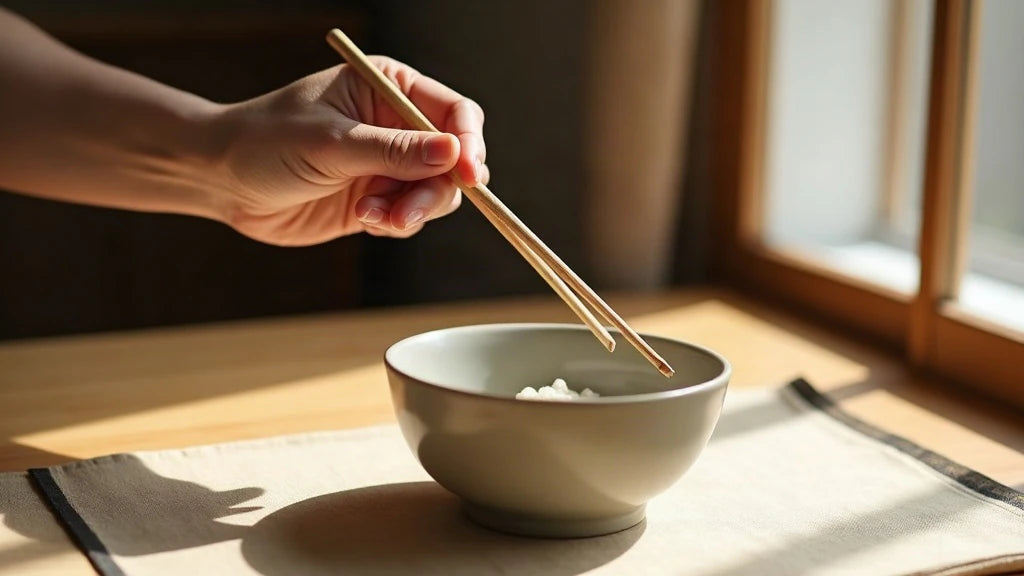
Japanese chopsticks are shorter than Chinese ones and taper to a finer point, which is a design response to the food: picking a small bone from a grilled fish, lifting a single bean, separating flakes of rice. Bamboo gives a slightly textured surface that grips, while lacquered wood is smoother and more formal. The cultural difference from Western cutlery is the one most people miss. In a Japanese home, chopsticks are personal. Each member of the household has their own pair, sometimes distinguished by length or colour, kept in a rest or a case rather than tipped anonymously into a drawer.
They are an eating tool and a cooking tool at once. I use a long pair to turn things in a pan, to beat eggs, to lift noodles from boiling water and to place garnish precisely on a plate. A rest, called a hashioki, keeps the tips off the table between mouthfuls. For a household moving away from disposable wooden chopsticks from takeaway bags, one good set ends that habit completely.

Bamboo is the practical choice for daily use because it grips rice better than a glossy lacquer finish. Care is strict but simple. Wash by hand, dry upright, do not soak, and keep them out of the dishwasher, where heat and detergent will dull and split them. Done that way a set lasts years. There is also etiquette attached, and it is not optional: never stand chopsticks upright in a bowl of rice, and never pass food directly from your chopsticks to someone else's, because both actions belong to funeral rites.
This is a gift of daily use disguised as a small object. The person touches it every evening. It also travels well, costs little to ship and fits any kitchen regardless of style. Give a set of pairs rather than a single pair, and mind the count, which the note below this section explains.
Give it to a couple moving in together, or settling into a first shared kitchen. Two personal pairs, each distinguishable, plus a rest for each, is a quietly affectionate gift: it says this table is yours now, and here is your place at it.
14. A Floor Chair for anyone who wants to sit low but needs a back
A tatami chair is a chair without legs. The seat rests flat on the floor and a hinged back rises behind you, usually adjustable through several angles. It exists because floor living is comfortable for twenty minutes and demanding for two hours. In a washitsu you would not drag in a dining chair, because legs press marks into tatami matting and a tall silhouette breaks the low horizon of the room. A legless chair solves both. You get back support at ground level and the sightlines stay low.
It belongs at a chabudai for long meals and long work sessions. I also use one turned towards a window for reading, with a floor cushion under the knees. Folded flat it leans behind a door or slides under a bed, so it becomes the seat that appears when guests stay and vanishes afterwards. For anyone who sits on the floor to practise an instrument, to meditate or to play games for hours, this is the piece that makes it sustainable.

The advantages are real: no legs to damage a floor, a folding form that stores, and a seat that keeps a small room feeling open. Now the limits, because this is the largest item here. It is still a floor seat, so standing up from it is work, and that matters for anyone with stiff knees or hips. Hinges can creak as they age. Most importantly, measure against the table. A floor chair under a table that is too high leaves you reaching up to eat, which ruins the point.
Given as a gift, it signals that you thought about someone's body rather than their shelf. That is unusual and it registers. It is also the piece people want but do not buy for themselves, because it feels like an indulgence next to a cushion that costs a tenth as much.
I treat this as a milestone birthday gift, and it suits the 60th especially, kanreki in Japanese custom, a birthday traditionally marked as a return to a beginning. The price makes it a natural group gift from several people, which also means nobody has to guess alone about the room it is going into.
15. Cooking small portions over charcoal on a Japanese BBQ Grill
A Japanese barbecue grill in the konro tradition is small, shallow and narrow. The charcoal sits close under the grate, so heat is intense and the cooking distance is short. That geometry is built for skewers: yakitori turns in a minute or two, not twenty. Compare it with a Western kettle grill, which is designed for volume, a lid and slow indirect heat. This is the opposite idea. It cooks a few pieces at a time, fast, in front of the people eating them, which makes the cooking part of the meal rather than a job done elsewhere.
Skewers are the obvious use, and the list goes further than chicken. Shishito peppers, mushrooms, spring onions, scallops in the shell, a small whole fish, aubergine slices, mochi rice cakes that puff and blister. Set it on a heatproof surface at table height outdoors and let people cook their own. Follow the manufacturer's instructions on fuel, clearances and surfaces, use it outdoors or in a properly ventilated space, and never indoors in a closed room, because charcoal produces carbon monoxide.

Its strengths are size and economy. It needs a small quantity of charcoal, it comes up to heat quickly, and it fits a courtyard, a roof terrace or a small patio where a full grill would not. The honest limits are the cooking area and the fuel. You cook in rounds rather than all at once, which is wonderful for six people eating slowly and frustrating if you are trying to feed fourteen at the same moment. Charcoal also has to be extinguished and disposed of safely, and some buildings forbid open flames on balconies, so check the lease before you buy this for someone.
As a gift it hands someone a way of hosting rather than a device. The person who receives it will use it with other people present, every time. That is a good thing to give to anyone who likes feeding their friends but has no garden to do it in.
Father's Day is where I usually place it, especially for someone whose cooking has become routine. It also works as a joint gift from colleagues for someone leaving a job, since it belongs to the part of life they are about to have more of. Include bamboo skewers and a bag of good lump charcoal so the first evening is ready to go.
Questions buyers ask me before they order
I do not know the person's taste. Which of these is the safest choice?
A matcha set, a bento box or a pair of chopsticks. All three are used, not displayed, so they do not have to match a room. Decor is riskier, because it has to live with someone else's walls and colours. If you want decor anyway, choose the hanging lantern or a printed fabric panel. Both are light, both are easy to move, and neither commits the person to a permanent fixture.
Are these pieces made in Japan?
No, and I would rather say that plainly. We curate Japanese-style and Japanese-inspired homeware, chosen for form, proportion and how the object behaves in a room. The traditions behind each piece are Japanese. The manufacturing is not something we claim. If authenticity of origin is the point of your gift, buy from a maker who can document it.
What does shipping and returns look like?
Shipping is free worldwide. Handling usually runs 3 to 5 business days, and transit usually runs 3 to 6 business days, both as estimates rather than promises. Customs and local carriers can add time, so for a dated occasion like a wedding or a December gift, order with margin. Returns are accepted within 30 days. Support is available Monday to Friday, 10:00 to 17:00 (GMT-7).
The apartment is tiny. What should I avoid giving?
Avoid anything tall or deep. A small space is ruined faster by a bulky silhouette than by a busy pattern. Skip the tatami chair and the grill unless you know there is floor room and a safe outdoor spot. Choose the noren, the lantern, the fan, the fabric panel or the vase. Each one adds atmosphere without taking floor area, and three of them store flat.
Is a wabi-sabi vase with an uneven glaze a defect, or the point?
It is the point. Wabi-sabi finds beauty in the worn, the asymmetric and the incomplete, so glaze pooling, a matte patch or a slightly off-centre mouth are intentional in that aesthetic. It does mean no two pieces look identical. If your recipient likes matched sets and clean symmetry, give them the matcha set or the lamp instead, and keep the vase for someone who already likes old things.
Fifteen objects, fifteen different rooms they belong to. If you only remember one thing, remember that the best Japanese gift for a home is the one the person will touch. A whisk that gets used on Sunday morning. A cushion that comes out when friends arrive. A lantern that changes the light every evening. Buy the small object with the daily gesture before the large object with the big gesture. Then wrap it in cloth, hand it over with both hands, and say less than you want to say.
Choose the gift by the room it will live in
Browse the pieces in this guide, from a hand fan to a tatami chair, and choose by the room it is going into. Free shipping worldwide, 30-day returns, and a human to ask Monday to Friday, 10:00 to 17:00 (GMT-7).
Browse the collection