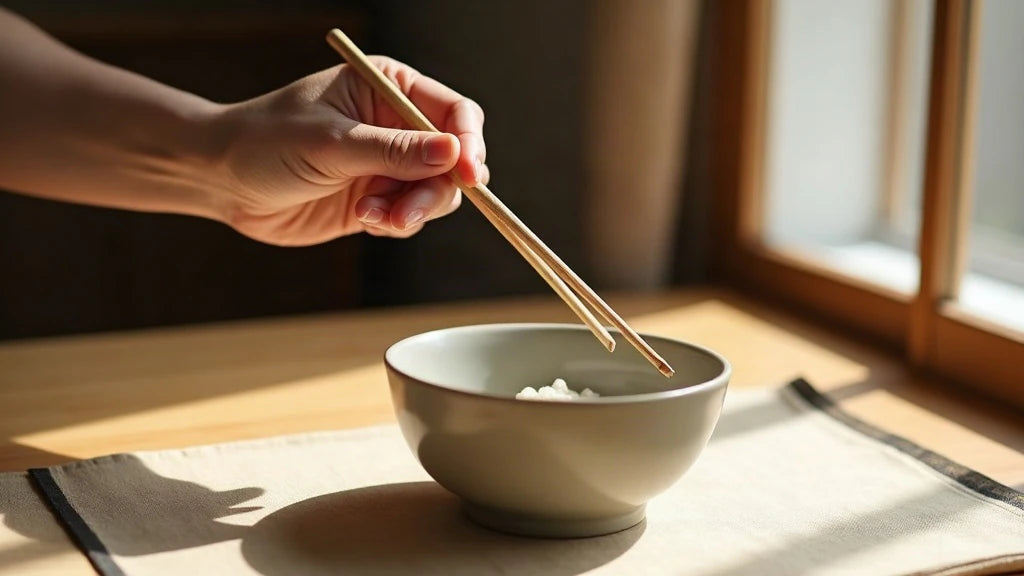
The first time I ate at a counter in Kyoto, I watched the woman beside me lift a single grain of rice, unhurried, with two slim sticks she barely seemed to move. My own hands were doing something closer to a crab impression. If you are looking for how to hold chopsticks without having grown up with them, the fix is mechanical, not mystical. Rest the lower chopstick in the crook of your thumb and on your ring finger, where it should stay completely still. Then hold the upper chopstick like a pencil, between your thumb, index and middle fingers. All the movement comes from that top stick. It opens and closes against the fixed one, like a hinge. Keep the tips level, hold the pair about two thirds of the way up from the tips, and a usable grip takes about ten minutes of practice.
Key points
- The bottom chopstick never moves: it rests on the ring finger and in the base of the thumb.
- The top chopstick does all the work, pivoting like a pencil between thumb, index and middle finger.
- Hold the pair roughly two thirds up from the tips and keep the tips aligned.
- Slightly textured wooden or bamboo chopsticks are much easier to learn on than smooth metal ones.
How to hold chopsticks correctly, step by step
Chopsticks, or hashi, work as a lever with a fixed base. One stick is the table. The other is the hand. Rest the lower stick in the web between your thumb and index finger, let it rest on your ring finger, and press your thumb gently against it. This stick should not move.
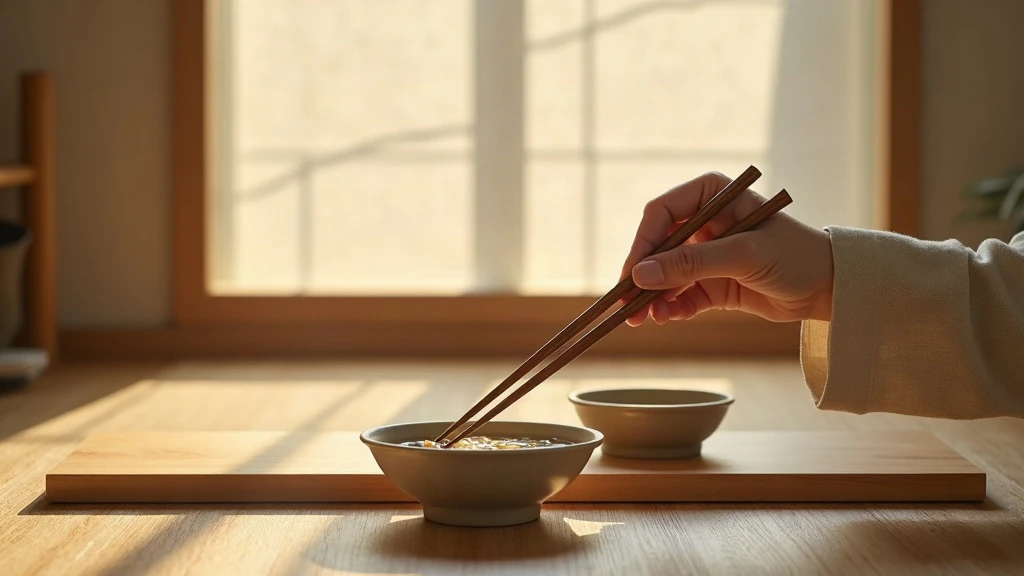
Pick up the second chopstick like a pen: thumb pad on one side, index finger on top, middle finger behind. Slide it parallel above the first one, with a small gap between them. All motion comes from your index and middle fingers opening and closing. Straighten them to lift the upper chopstick, curl them back to close it against the lower one. That is the full range of motion. Tap the tips together to check your alignment.
Grip about two thirds of the way up from the tips to leave enough leverage and reach. Keep the tips level by tapping them lightly on the table before you start.
Wood, bamboo or metal chopsticks: easiest to learn on?
A beginner hand needs friction. Precision comes later; grip comes first. The material under your fingers decides how much you can get wrong before the food slides.
Wood and bamboo both have a faint grain that catches on food and are light, so your fingers are not fighting the weight of the utensil. When a friend asks me what to start on, I hand them a plain pair of wooden chopsticks rather than anything glossy, because the surface does half the work while the fingers are still learning.

Polished metal has almost no surface drag. Tofu slides, noodles escape, and the natural reaction is to squeeze harder, which breaks the hinge. Metal pairs are also heavier, so small corrections need more effort. They are common in Korean dining but punish a grip that is still forming.
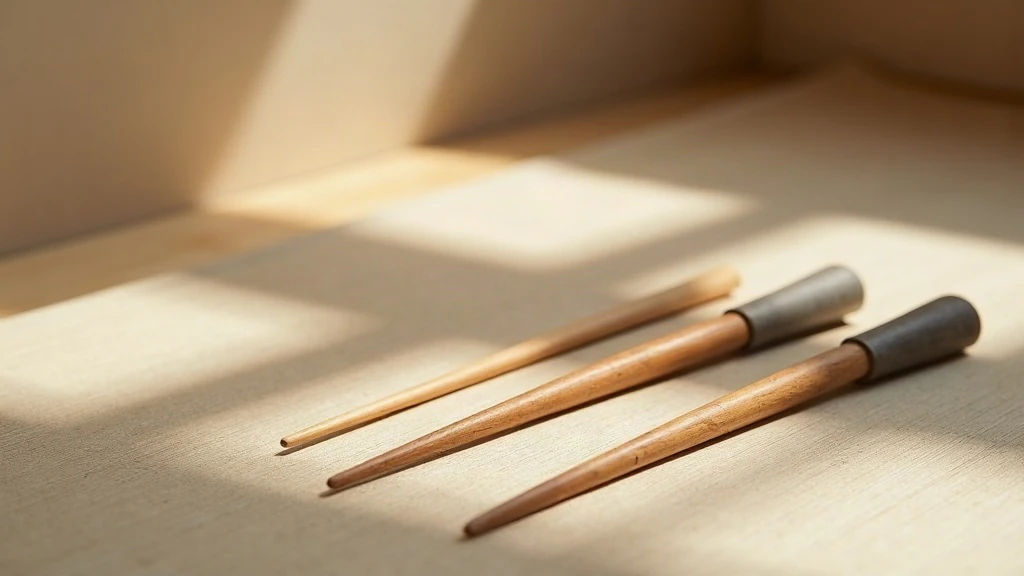
Most Japanese pairs run about 9 inches (23 cm), with shorter versions for smaller hands. Tapered chopstick tips suit picking up sushi and single grains. Blunter Chinese-style ends are more forgiving when you are learning. Waribashi, the disposable wooden chopsticks that snap apart, were designed so diners could see the pair had never been used, and the rough split edge grips food better than polished pairs at home.
Finger by finger: where each one sits on the chopsticks
If the grip feels wrong somewhere, the fault is almost always one specific finger doing a job that belongs to another.
Your thumb has two contact points and neither of them pushes. The base holds the lower stick against your hand. The pad rests on the upper stick and acts as the hinge. Keep the thumb slightly bent and passive.
The index and middle fingers carry all the motion, working as a unit the way they do on a pencil. The movement is small, maybe half an inch at the tips. If your whole wrist is swinging, the fingers are not doing their share.
The ring finger is the shelf the lower chopstick sits on, and the little finger simply tucks behind it to keep that shelf steady. If the bottom chopstick moves while you eat, the problem is almost never the top hand. Firm up your ring finger, keep both fingers gently curled, and the lower stick goes still again.
Practicing chopstick control with everyday food
Grip is learned at a table, not in theory. Start with food that forgives a loose pinch and move toward food that does not. Give it one meal at a time rather than one long session.
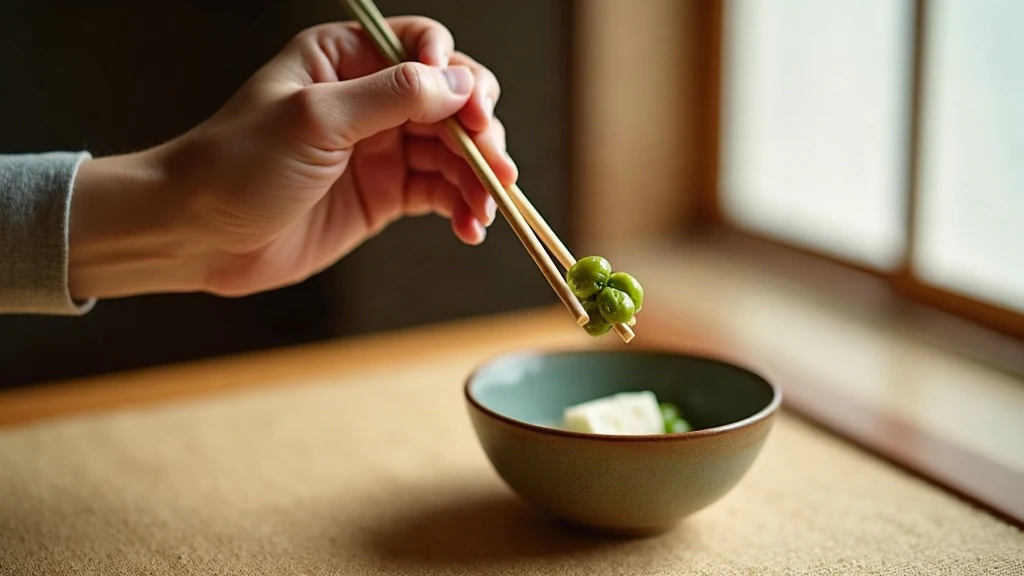
Begin with cubes of firm tofu, then edamame pods and cooked vegetables cut into bite-size pieces. Next come dumplings and pieces of chicken, which need a slightly firmer close. Rice and noodles come last. For rice, gather a small clump rather than chasing single grains.
Lifting the bowl toward you is normal practice in Japan and the single biggest reduction in dropped food. A short trip from bowl to mouth leaves less distance for a weak grip to fail. The piece I reach for most while someone is learning is a kobachi bowl, because it sits in the palm at the right height and keeps the portion small enough that nothing has to be chased around the rim.
Common chopstick grip mistakes, and how to fix them
Every one of these is a mechanical fault with a one-line correction.

If the tips scissor past each other instead of meeting, the cause is nearly always that the two sticks are not parallel. Pull them apart, re-seat the lower one on the ring finger, then lay the upper one down so both run on the same line. Tap the tips flat on the table to level them.
Holding low feels safer because it shortens the lever, but it costs you reach. Slide your fingers back until you are two thirds of the way up.
If your hand aches after ten minutes and the tips open barely at all, you are using a fist grip where all four fingers wrap the sticks. Release the ring and little fingers from the upper stick and put them back under the lower one. The hinge should feel almost lazy.
Squeezing too hard crushes soft food and tires the hand within minutes, so hold just firmly enough that nothing slips. Holding the sticks at a steep downward angle makes the tips meet point-on instead of face-on, which drops everything round. Flatten the angle so the last inch of each stick lies closer to horizontal.
Chopsticks in a full Japanese place setting
Once the grip is working, the table around it starts to matter. Chopsticks lie horizontally, parallel to the edge of the table, in front of you and closest to your body. The tips point left for right-handed diners. The rice bowl sits on the left behind them, the soup bowl on the right. Between courses, the tips go on a chopstick rest (hashioki), a small ceramic or wooden piece that keeps them off the cloth and stops them rolling.
Keep the materials in conversation. Matte wood and unglazed ceramic sit well together; a high-gloss lacquered pair wants smoother bowls beside it. The other object your hand holds through the same meal is the cup, which is why I keep a Japanese tea cup set within reach of the table rather than in a cupboard: the same hand that has just put the chopsticks down picks it up, and the weight and finish should feel cohesive.

Chopstick questions people ask most
Once the grip settles, the next questions are about context and exceptions. They come up most often over a meal, when someone is learning what they can bend and where the rules actually matter.
Can I eat sushi with my hands instead?
Yes. Nigiri is traditionally eaten with the fingers. Sashimi is taken with chopsticks.
Should the chopsticks touch along their length?
No. They stay parallel with a small gap between them, meeting only at the tips when you close.
How do I pick up something slippery?
Lower the tips so more of their surface meets the food, rather than pinching with the points. Approach from the side and lift slowly.
Is it normal for my hand to ache at first?
Yes, for the first few sessions. It usually means you are gripping harder than you need. Loosen the pinch and shorten your practice to five minutes at a time.
FAQ
The broader questions about chopsticks touch on whether there is one correct way, how long it takes, and which hand to use. Here are the ones I answer most often.
Is there a right and wrong way to hold chopsticks?
There is a standard grip, and it exists because it works: fixed lower stick, moving upper stick, three fingers doing the hinge. Plenty of adults in Japan hold them slightly differently and eat perfectly well. But the standard grip is the most stable and the least tiring.
How long does it take to learn to hold chopsticks?
About ten minutes for a grip that works on tofu and vegetables. Roughly a week of regular meals before it stops requiring attention. Rice and noodles usually feel natural after two or three weeks.
Which hand should you hold chopsticks in?
Whichever hand you write with. Left-handed use is entirely normal, and the grip is simply mirrored.
Why do my chopsticks keep crossing at the tips?
Because the two sticks are not lying parallel, or because the lower one has slipped off your ring finger. Re-seat the bottom stick first, then place the top one so both run along the same line.
Are chopstick training aids worth using as an adult?
A chopstick training aid, the small hinged clip that joins the pair at the top, can help for a day or two if your fingers keep collapsing into a fist. Set it aside quickly though, since it does the stabilising work your ring finger needs to learn.
If you are building the table around the meal rather than just the grip, our Japanese tableware collection brings together the bowls, cups and small dishes that sit well with a simple pair of chopsticks.
Explore the Japanese Tableware collection
Browse the Japanese tableware collection to build a place setting around your chopsticks: bowls, rests, cups and serving dishes.
Browse the collection →