A friend once brought me twenty-four roses for a housewarming. They were beautiful, and I had nowhere to put them. The next morning I cut one branch of flowering quince from the hedge, added a single white chrysanthemum, and set them in a narrow ceramic vase by the window. That second arrangement held the room. Ikebana is the Japanese art of arranging flowers around line, space and season rather than volume. Where a Western bouquet fills a vase with as many blooms as it can hold, an ikebana arrangement may use three stems and treat the air between them as part of the design. The container, the angle of each branch and the emptiness around them all count as material.
Key points
- Ikebana builds an arrangement from line and empty space, not from the number of flowers.
- Most styles follow three structural lines, shin, soe and hikae, set at different heights and angles.
- The vase is part of the composition: a narrow neck holds stems upright, a shallow suiban needs a kenzan pin frog.
- Seasonality rules the material: you cut what is actually happening outside, often one branch and one flower.
Ikebana vs a Western bouquet: fewer stems, more space
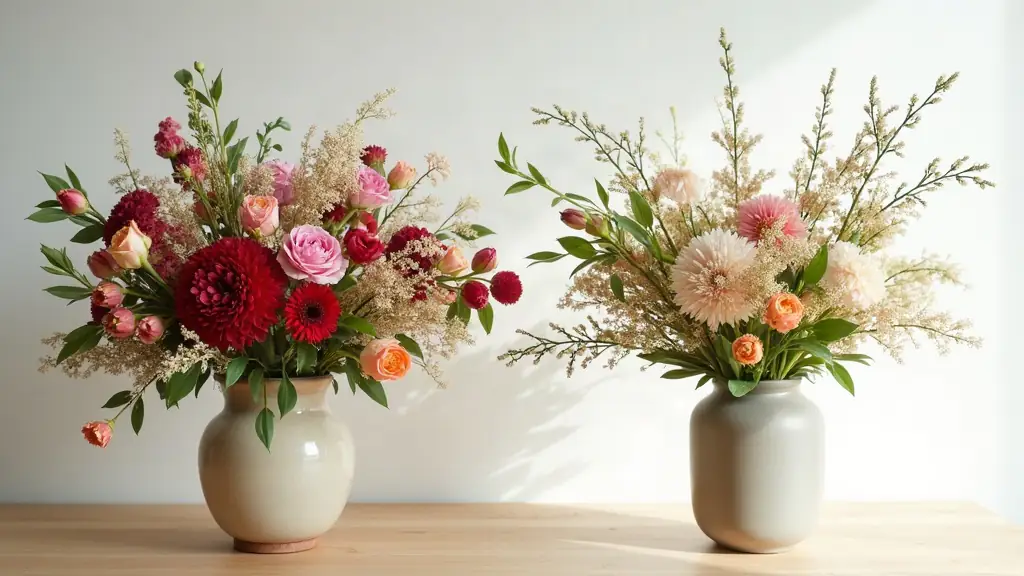
The difference is not a matter of taste. The two traditions have opposite goals. A Western bouquet is built to be seen from any side, as a mass of colour, and its beauty grows with abundance. An ikebana arrangement is built to be read from one side, as a set of lines, and its beauty grows with subtraction.
Why three stems can hold an ikebana arrangement together
Put one branch with a few leaves, one open flower, and one short bud at three different heights. The eye travels from the tallest tip down to the lowest bloom, and that travel is the composition. Three stems work because each one has a job: one sets height and direction, one widens the shape, one grounds it near the rim.
A pair of sharp flower shears does most of the work. Practitioners spend more time cutting away leaves than adding stems, since a fourth stem of the same length blurs the structure.
Ma: the empty space around each ikebana stem
Japanese design calls this interval ma: the active emptiness between things. The gap between two stems is not leftover; it is sized and chosen. If you move the lowest flower closer to the tallest branch, the arrangement tightens and loses its breath. You are looking at the shape of the air as much as the shape of the plants.
The ikebana vase counts as part of the composition
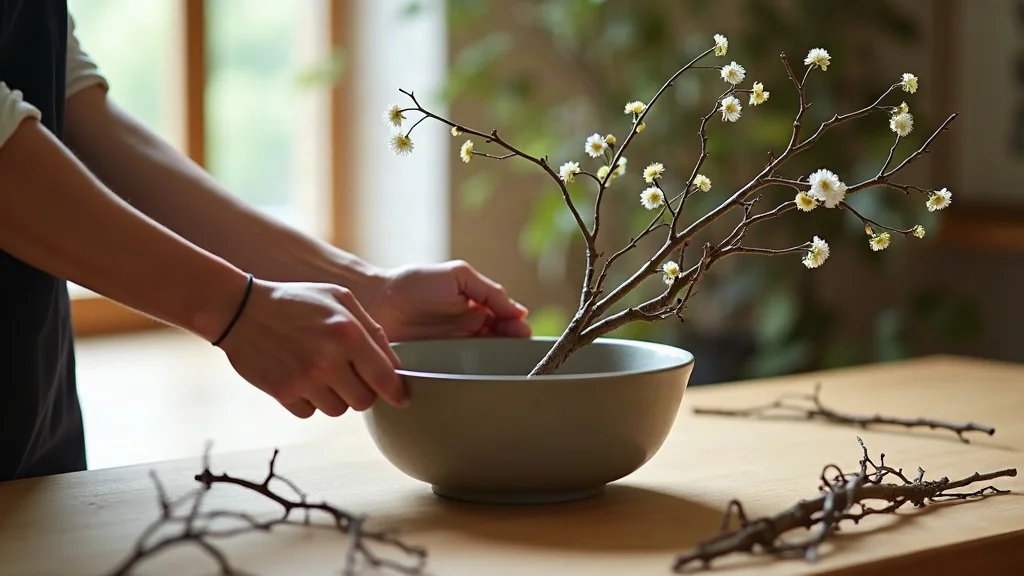
An ikebana container is part of the structure. Its mouth decides whether a branch can lean or must stand upright, and its proportion against the stems is part of the composition. A tall vessel with a narrow neck holds angles without hardware. A shallow basin needs a pin frog. For a first arrangement, I point people to the narrow-necked kind, like the ceramic vase I keep on my windowsill, with a matte glaze where two stems stay exactly where I place them.
Kadō: how ikebana grew from altar flowers to an art
Ikebana did not begin as decoration. Its roots are in Buddhist offerings, where flowers were placed before an altar as an act of respect. Over centuries that offering became a discipline with teachers, rules and schools. The formal name for it is kadō, the way of flowers.
From Buddhist altar offerings to the way of flowers
Altar flowers were arranged upright and symmetrical. As the practice moved into reception rooms, it acquired a new setting: the tokonoma, a recessed alcove with one viewing angle and a neutral back wall. The rules about front, height and asymmetry that students learn come from arranging flowers inside this box with three walls.
Ikenobō, Ohara and Sōgetsu: three schools of ikebana
The Ikenobō school teaches classical upright styles. The Ohara school is associated with moribana, lower arrangements in shallow basins. The Sōgetsu school treats ikebana as sculpture and allows dried material and bare branches. All three teach line, space and seasonal honesty; you are choosing a teacher, not a philosophy.
Why ikebana is taught as a practice, not a recipe
There is no list of flowers that produces a correct arrangement. There are proportions, angles and a habit of looking. Classes repeat the same basic form for months with different material each week, because the material is what changes.
That repetition is the point. You learn to see where a branch already wants to bend, and to cut accordingly instead of forcing it. A recipe would remove the only skill worth having.
Where to place a Japanese flower arrangement at home
Placement decides whether an arrangement reads or disappears. An ikebana composition has a front, a height and a background, and all three assume the viewer is in a known position. Most apartments have no alcove, so you build the conditions instead: one viewing direction, a plain wall behind, and a surface at the right height.
Viewing an ikebana arrangement from a seated height
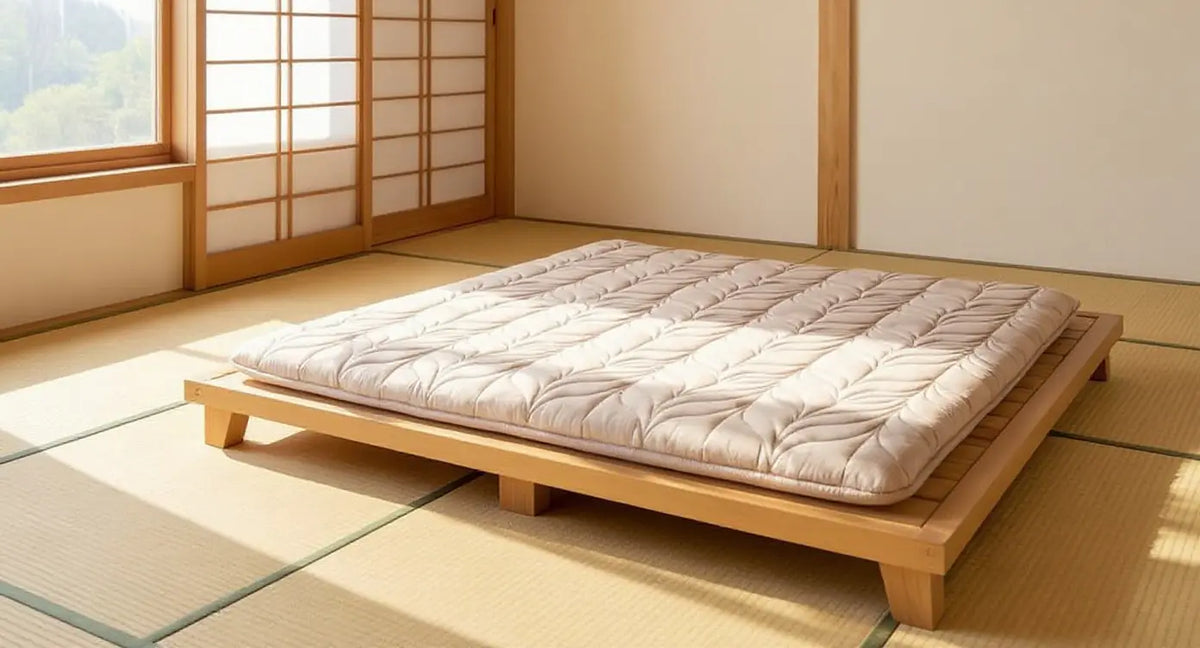
Traditional Japanese rooms are lived in low. Sitting on the floor puts your eye around two feet up. A low table, floor cushion or tatami mat sets the whole scene. I keep a Japanese tatami mat in my reading corner because the woven igusa straw gives me a neutral ground plane and fixes my seated height so the vase reads from the side.

No tokonoma? Shelf and corner spots for a small ikebana
Three spots work well in apartments: an open shelf at chest height with nothing else, a corner side table where two walls meet, or the end of a low sideboard set to one side. Keep the surface empty. One arrangement, one surface.
Light, drafts and heat: what wilts an arrangement fastest
Moving dry air is the main enemy: air vents, heating registers and frequently opened doors will cost you days. Direct sun heats the water. Soft, indirect light suits the work. Change the water every day or two and recut the stem ends at an angle.
Shin, soe, hikae: the three lines of ikebana
Classical arrangements are built from three structural stems, and almost every traditional form is a variation on their lengths and angles. Learning them gives you something to measure against.
Shin, the tallest line that sets the arrangement's height
The shin is the primary, longest stem, usually a branch. Make it roughly one and a half times the height plus the diameter of the container. Shin leans slightly forward and to one side. Everything else is cut relative to this stem.
Soe and hikae, the two stems that answer it
Soe is the secondary line, commonly around two thirds the length of shin, angled further out to build width. Hikae is the third, shorter again at roughly a third to a half of shin, placed low and nearest the front.
Read together, the three tips form a scalene triangle: no two sides equal, no symmetry. Asymmetry is the signature of the form. If your three tips line up evenly, shorten one and swing it outward.
Moribana vs nageire: two ways to hold the lines
Two styles dominate beginner classes, and the difference is mostly mechanical: what holds the stems in place.
Moribana means piled-up flowers; nageire means thrown in. Start with moribana if you want predictable results, with nageire if you want fewer objects on your shelf. Both teach the same three lines.
Chabana and the seasons: ikebana at its most spare
There is a style that removes even more. Chabana, tea flowers, is the arrangement made for a tea gathering, and it is deliberately humble: often a single seasonal stem in a plain vessel, placed in the alcove where guests will see it once. The tea master Sen no Rikyū is said to have advised arranging flowers as they are in the field, which is as close to a rule as chabana gets.
One flower, one season: what chabana removes
Chabana drops the formal structure and showiness. What remains is one stem genuinely in bloom that week, in a bamboo tube or small ceramic jar. Leaves are left a little imperfect. The stem sits as though still growing.
Reading the calendar before cutting a single stem
You cut what is actually happening outside. Bare branches in late winter, plum or cherry for hanami (spring blossom season), grasses and bellflower in summer, reddening maple or chrysanthemum in autumn. Out-of-season material is a mistake. Seasonal branches carry the date in them.
Ikebana for the tea moment, not for the room
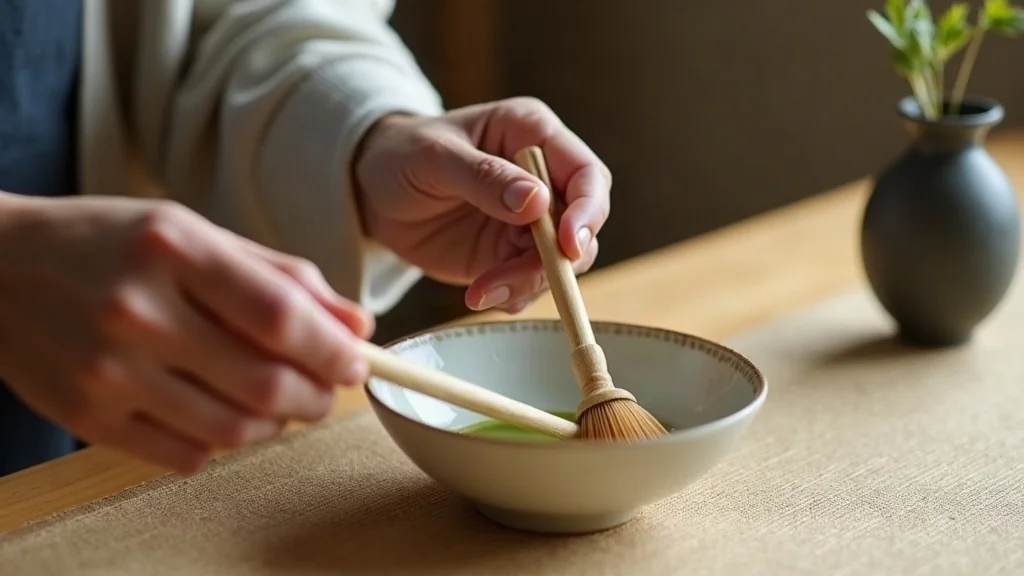
Chabana exists for one gathering, often made the same day. If you want to feel why it is so restrained, make tea beside it. Whisking matcha takes just long enough to actually look at the flower.
FAQ
Is ikebana hard to learn on your own?
The basic three-line structure is learnable from books and practice, and many people work this way for years. What a teacher adds is correction: they see when your soe is fighting your shin, which is hard to judge in your own work. Start alone, and consider a class only if you want to progress inside a specific school's curriculum.
What flowers can I use for ikebana?
Whatever is in season where you live. Branches, grasses, berries, leaves and a single open flower all count as material, and foliage is often more useful than blooms. Chrysanthemum, iris, pine, bamboo and camellia are classical choices, but a hedge clipping with a good curve works just as well.
Do I need a kenzan pin frog to start?
Only if you want to use a shallow container. In a tall vase with a narrow mouth, the neck itself grips the stems, and a short cross-piece of cut stem wedged inside gives you extra control. Buy a pin frog when you move on to moribana in a flat basin.
How long does an ikebana arrangement last?
Expect several days to about a week, depending on the material and the room. Woody branches and foliage outlast soft flowers considerably. Changing the water, recutting the stem ends and keeping the vessel away from vents and direct sun makes the biggest difference.
What is the difference between ikebana and a bouquet?
A bouquet is arranged as a mass, viewed from all sides, and judged by fullness. Ikebana is arranged as a set of lines, viewed from one side, and judged by the space between them. The container and the empty air are part of an ikebana composition in a way they never are in a bouquet.
If you are ready to place your first two stems, the shapes in our ikebana vase collection are chosen for narrow necks and quiet glazes rather than volume. Take your time with the proportions, and let the vessel do some of the holding.
Does starting ikebana require a lot of equipment?
Can I use supermarket flowers?
How much time does one arrangement actually take?
Explore the Ikebana Vase collection
Narrow-neck vases for a single branch and shallow bowls for moribana, with dimensions listed so you know what each one can hold.
Browse the collection →