The first thing I notice in a Japanese home is not the furniture. It is the shoes: one pair, placed neatly on the lower floor by the door, and nothing else. In a Japanese home, shoe storage entryway problems are solved by a limit rather than by furniture: one pair per person stays out on the lower floor of the genkan (the sunken entry area where you remove your shoes), everything else goes out of sight, and a visible line marks where the house begins. Keep the storage low, shallow and against one wall, leave the floor in front of it empty, and hang a noren to signal the boundary between outside and inside. That single gesture, step down, shoes off, step up, does more for a calm entryway than any extra cabinet.
Key points
- A genkan works on a rule, not on capacity: one pair out per person, the rest closed away.
- Low and shallow beats tall and deep. Storage under knee height keeps the entry feeling open.
- Leave the floor in front of the shoes empty; that empty strip is what reads as calm.
- A noren at the inner doorway marks the outside/inside line without adding a single piece of furniture.
What a genkan is, and why shoe storage starts there
The genkan is not a hallway. It is a threshold with two floor levels, built so that outside and inside never touch. Understanding those two levels tells you where shoes belong before you buy anything to hold them. Every storage decision that follows comes from this one piece of architecture.
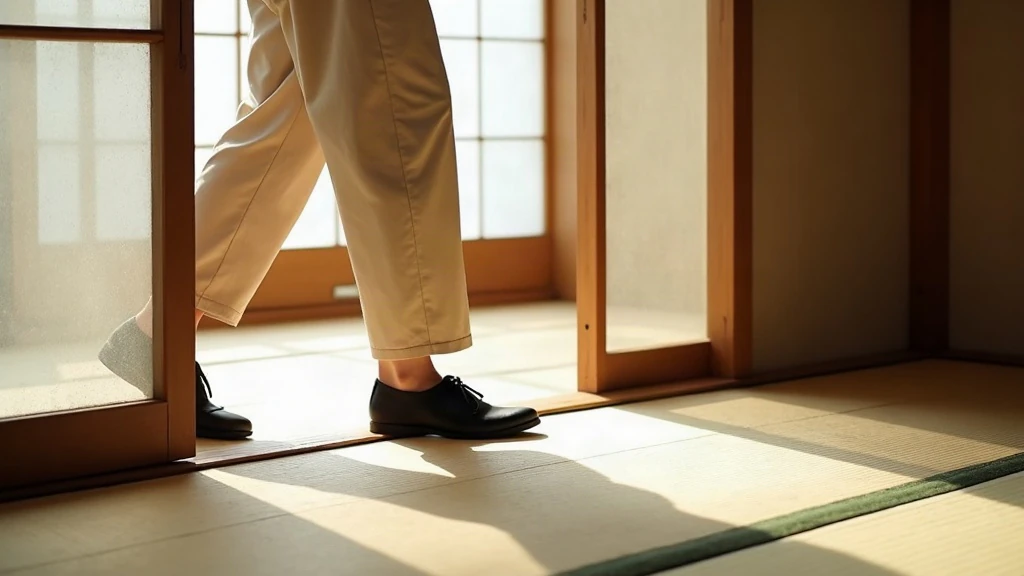
The two levels of a genkan: tataki floor and step up
The lower floor is the tataki floor, traditionally packed earth, more often concrete, tile or stone today. It sits a few inches below the rest of the house. That lower plane counts as outside, so shoes are allowed there and nowhere else.
Then comes the step up threshold, usually between 4 and 8 inches (10 to 20 cm) in older houses, shallower in modern apartments. You sit or lean on that edge, remove your shoes on the low floor, and step up in socks or house slippers. The height is deliberate. It is tall enough that no one forgets it is there.
Why Japanese entryways keep only one pair of shoes out
A genkan stays calm because the number of visible pairs is fixed, not because the space is large. One pair per person, lined up with the toes pointing back toward the door. Guests' shoes are the exception, and they are usually turned for them by the host.
This is the part most entryway guides skip. They solve for capacity, so they recommend a bigger rack, and a bigger rack simply holds more visible clutter. Decide the rule first. The furniture then becomes small.
A genkan is not a mudroom or a drop zone
An American mudroom absorbs things: bags, sports gear, coats, mail. A genkan does the opposite. It is a filter you pass through, and the floor in front of the step stays clear so two people can pass each other.
If you treat your entry as a drop zone, no storage system will hold. Move the bags and mail a few feet further in, to a shelf in the hall or a hook inside a closet. The genkan keeps shoes and nothing else.
A noren at the genkan: the line between outside and in
Once the shoes are handled, the entry still needs a boundary. In a Japanese house that boundary is often fabric, not a wall or a cabinet. A split curtain hung in the inner doorway closes the view into the house while letting you walk straight through with full hands. It costs you no floor space at all, which is why I reach for it in small apartments before anything else.
Hanging a noren where the entryway meets the hallway
A noren curtain is a short fabric panel, split vertically into two or three sections, hung from a rod through a sewn channel at the top. Hang it at the inner doorway, where the raised floor begins, not at the front door itself. From the step up, it reads as the first wall of the house.
The split is what makes it work. You push through with an elbow or a shoulder, and the panels fall back on their own. For my own entry I use the Japanese Noren Doorway because the panels are long enough to hide the hallway without touching the floor, and I can lift it off the rod and wash it after a muddy week.

Height, width and clearance for an entryway noren
Standard interior doorways run about 32 to 36 inches wide (81 to 91 cm). Measure the rod span, not the door leaf, and allow the panel to be an inch or two wider so no gap shows at the sides.
For length, two rules keep it usable. Leave the bottom hem at least 12 inches (30 cm) above the floor if you carry bags through, so nothing snags. If you want more privacy, drop it to knee height and accept that you will brush past it.
Fabric and color that suit a dim genkan
Most entryways get little daylight. A pale linen or cotton panel lifts that dimness, and the weave shows the light coming through from the hall. Indigo, charcoal and clay-brown hold up better against scuffs near the floor.
Weight matters by season. A light cotton panel moves with the door in summer. A thicker weave hangs still in winter and blocks the draft that comes in with the mail. I keep two and swap them, the same way you would swap a throw.
Shoe storage entryway ideas that stay low and quiet
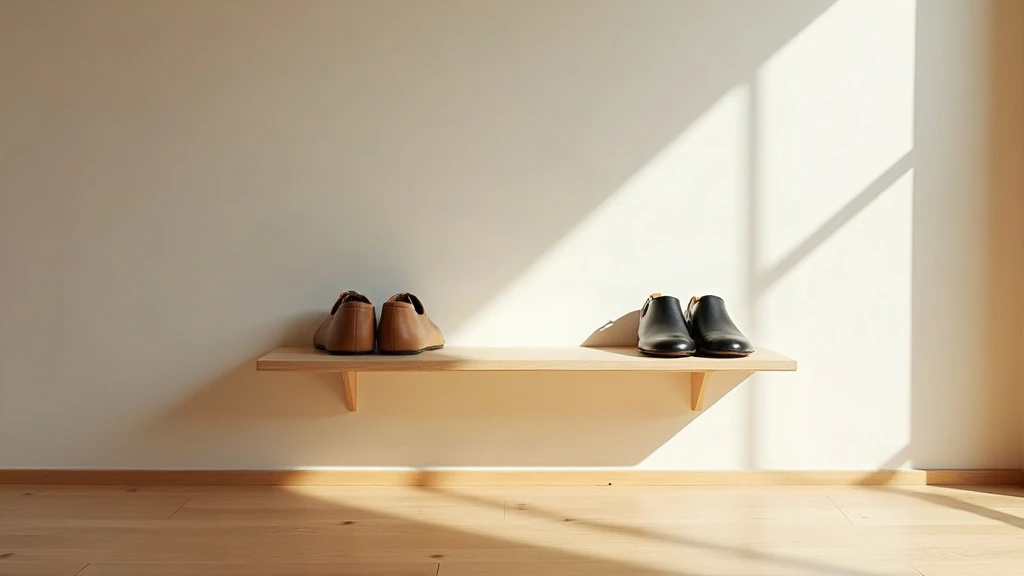
Here is the practical core. Everything that holds shoes should sit below knee height, press flat against one wall, and stay shallow enough that you never step around it. One line of storage, one wall, one empty strip of floor. That is the whole system.
Low shoe shelves under a genkan window or coat hook
Aim for a shelf unit no taller than 18 to 20 inches (45 to 50 cm). At that height it reads as part of the floor rather than as furniture, and the wall above stays open for a hook or a single framed piece.
Three tiers is usually enough for two people's current-season pairs. Put the shoes you wear daily on the middle tier, at hand height when you crouch. The bottom tier takes the heavy boots, because weight low down makes the piece feel settled.
Shallow depth: shoe storage in a narrow entryway
Depth is the number that decides whether a narrow entry works. Keep it to 10 to 12 inches (25 to 30 cm). Adult shoes are roughly 11 to 12 inches long, so at that depth you store them turned sideways, heel to the wall, or angled on a sloped tier.
For small entryway storage, a sloped or tilted shelf gains you two or three inches of clear floor without losing a pair. A wall-mounted shelf with nothing underneath is the other move: the floor sweeps clean in one pass, and the eye reads the open space under it as width.
Whatever you choose, protect the strip of floor directly in front. Eighteen to twenty-four inches (45 to 60 cm) of empty tataki is what makes an entry feel finished. A doormat belongs outside the door or flat on the lower floor, never half under the shelf.
Baskets and lidded boxes for off-season pairs
Sandals in February and snow boots in July are the real source of entry clutter. Pull them out of the daily line entirely. A lidded box or a woven basket on the top shelf of a nearby closet holds a season's worth and closes the visual noise.
Label the lid or use one basket per person. Then do the swap twice a year, at the turn of spring and the turn of autumn, so the shelf by the door only ever carries what you are actually wearing.
How much light a genkan shoe corner actually needs
Less than you think, and from lower down. A bright ceiling spot in an entry throws hard shadows across the floor, and every scuffed toe and stray lace shows up in sharp relief. The goal in a genkan is glow rather than glare: warm, diffuse, close to the ground.
Soft light over the shoe shelf instead of a ceiling spot
If you can, skip the overhead fixture when you come home at night and light the shelf area instead. A single warm source, somewhere around 2700K, puts soft light on the floor where you need to see your feet. The rest of the entry can stay in shadow, which is what makes the step up feel like an arrival.
Shaded or paper-diffused light does this better than a bare bulb. Washi, the Japanese paper made from plant fibers, spreads light evenly and keeps the shadows soft at the edges.
A lantern at knee height for the step up
Light placed low does the real work in an entryway. Set it on the shoe shelf or on a low ledge beside the step, so the glow falls across the threshold rather than down from above. In my own genkan I hang a Chochin Lantern low near the step, because the paper softens the only light source in a space with no window and the pleats catch just enough of it.
Keep the fixture away from the swing of the front door and away from the walking line. A low light you knock into every evening is worse than no light at all.
Getabako vs open shoe rack in a Japanese entryway
These are the two real options, and they fail in different ways. A closed cabinet hides everything and demands that you open a door. An open rack is faster but shows you every pair, every day. Which one suits you depends less on taste than on how many pairs pass through your door each week.

The getabako: closed doors, one calm surface
A getabako shoe cabinet is the traditional genkan unit, named for the geta wooden sandals it once held. Doors close over the tiers, so the entry presents one quiet front and a flat top.
The trade-off is air. Shoes need to dry, and a closed box slows that down. Leave the doors open for an hour after wet weather, or choose a unit with a slatted or vented back.
Open shoe racks: faster to use, harder to keep tidy
An entryway shoe rack wins on speed. You step out of your shoes, slide them onto a tier, and you are done. Shoes dry properly, because air moves around them.
It also wins on cost and on depth, since there are no doors to clear. The price is discipline: an open rack only looks calm if the pairs are aligned and the count stays fixed.
Choosing by pairs per person and entryway width
My rule is simple. If your entry wall is under 40 inches (100 cm) or you live alone, take the open rack, keep it to three tiers, and keep the pairs aligned. If three or more people share the door, or anyone stores more than six pairs there, the closed cabinet is worth the depth it takes, because hidden mess is the only kind that stays quiet.
One print above the genkan shoe shelf, nothing more
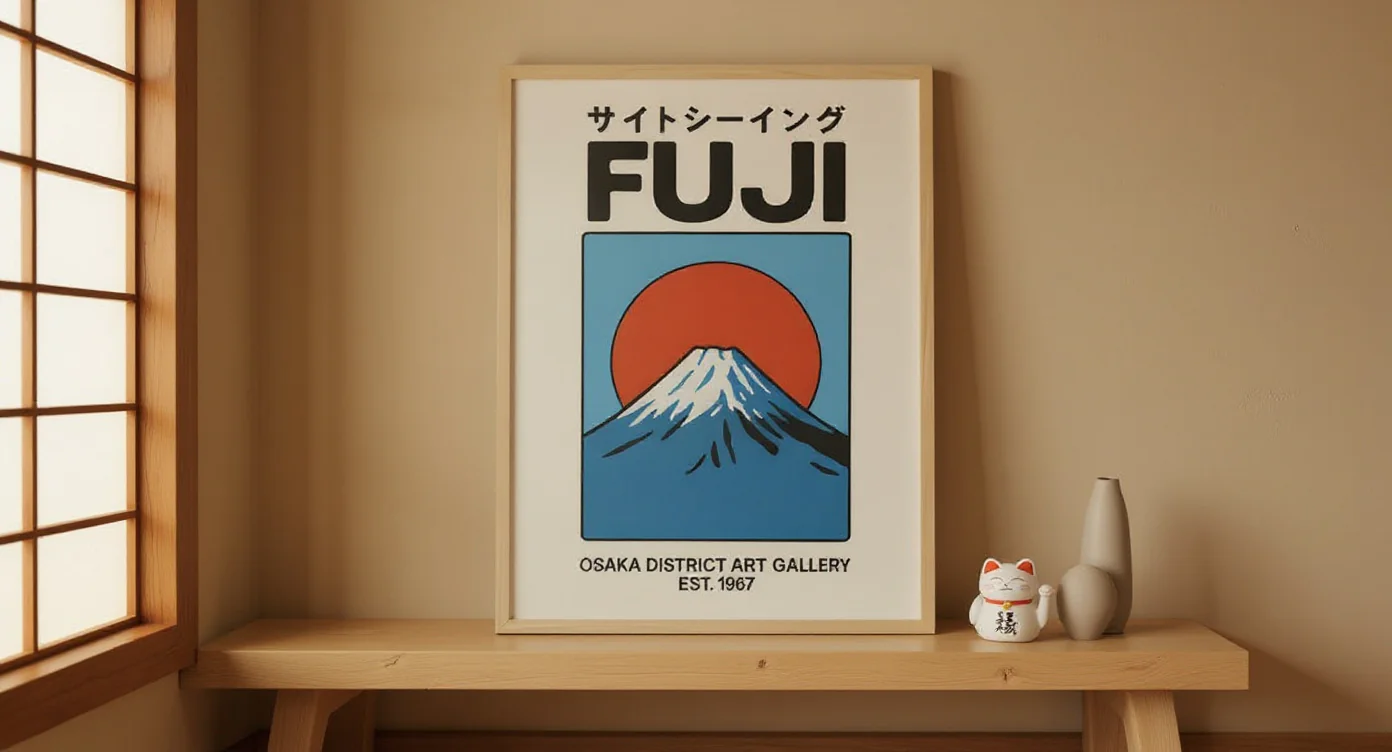
The wall above the shoes is where most entries go wrong. One framed piece, hung at eye level, and an empty shelf top below it. That restraint is borrowed from the tokonoma, the recessed alcove in a traditional room that displays a single object at a time.
Why a Japanese entryway displays a single object
A tokonoma holds one scroll, or one scroll and one arrangement. Nothing competes, so the eye settles. Your entry wall is small, and it is the first thing a guest sees, so the same logic applies with even more force.
That also means keeping the shelf top bare. Keys, sunglasses and loose change migrate there within a week. Give them a small closed box one room further in.
Hanging height above an entryway shoe shelf
Center the piece at about 57 to 60 inches (145 to 152 cm) from the floor, which is standing eye level for most people. Leave at least 10 to 12 inches (25 to 30 cm) of clear wall between the bottom of the frame and the shelf top, so the two do not read as one block.
Scale it to the shelf, not to the wall. A frame roughly half to two thirds the shelf width sits comfortably above it. When a reader has a dim minimalist Japanese entryway and one bare wall, I usually point them to a Japanese Retro Poster, because the muted colors carry in low light and a single print does not crowd a narrow space the way a gallery arrangement would.

What to rotate with the seasons in a genkan
Rotating one thing keeps a small entry alive without adding to it. Swap the print or the noren panel at the turn of a season, and change nothing else.
Pale, light fabric and a soft print for spring and hanami, the cherry blossom viewing season. Deeper indigo and a heavier weave once the weather turns. One in, one out, always.
FAQ
Below are the questions I hear most. Short answers follow, because the work of a calm entry is mostly about what you choose not to show.
Do Japanese homes have shoe cabinets?
Most do. The getabako is a standard fitting in Japanese apartments and houses, often built into the genkan wall rather than bought as a separate piece. Where there is no cabinet, a low open rack against one wall takes its place.
Where do you put shoes in a genkan?
On the lower floor, the tataki, never on the raised level. Daily pairs go into the rack or cabinet along one wall, and only one pair per person stays out. The strip of floor in front stays empty so people can pass.
Should shoes face in or out when you take them off?
Toes point back toward the door. You step up first, then turn and align your shoes facing out, so the next person entering sees a tidy line and you can step straight into them on the way out. Hosts often do this for a guest's shoes as a quiet courtesy.
How do you store shoes in a small entryway without a cabinet?
Go shallow and go up the wall. A wall-mounted shelf 10 to 12 inches (25 to 30 cm) deep holds daily pairs and leaves the floor clear underneath, and a lidded basket in a nearby closet takes the off-season ones. Cutting the number of pairs by the door does more than any new unit.
Do you need a bench in a Japanese entryway?
No. The step up is the seat, which is part of why that height exists. A shoe bench is worth it only if sitting down matters for you or someone in the house, and then keep it narrow, backless and under knee height.
If you would like to mark that line between outside and inside in your own entry, the Japanese Curtains collection gathers the noren panels and lengths I draw on most when a reader asks where the house should begin.
Explore the Japanese Curtains collection
Browse our Japanese noren curtains to draw that line at your own door: linen and cotton panels, standard doorway widths, with matching rods.
Browse the collection →