The first time I sat on a temple veranda in front of a dry garden, I waited for something to happen. Nothing did, and that was the whole lesson. A zen garden, or karesansui in Japanese (literally "dry mountain water"), is a composition of stone, raked gravel and moss that suggests water, mountains and islands without using a single drop of water. It was developed around the Zen temples of Kyoto as something to be looked at from a fixed, seated position rather than walked through. That makes it easier to translate indoors than people expect. What you really need is one strong object, a lot of deliberate empty space around it, and somewhere to sit and look.
Key points
- A zen garden is a dry landscape: stone and gravel stand in for water, islands and mountains.
- Its composition rule is asymmetry and odd numbers, with one dominant stone and nothing competing with it.
- The empty space around the stones does as much work as the stones themselves.
- Indoors, a single branch in a vase on a cleared surface reproduces the same effect without gravel.
What is a zen garden? Karesansui in plain terms
The form took shape in Japan during the Muromachi period, roughly the fourteenth to sixteenth centuries, in the grounds of Zen temples. The three characters in karesansui mean dry, mountain and water. Water is implied, never present. Gravel becomes sea or river, a flat stone becomes a shore, an upright stone becomes a peak. Some gardens include a karedaki, a dry waterfall, where stacked stones suggest falling water on a slope with nothing running down it.
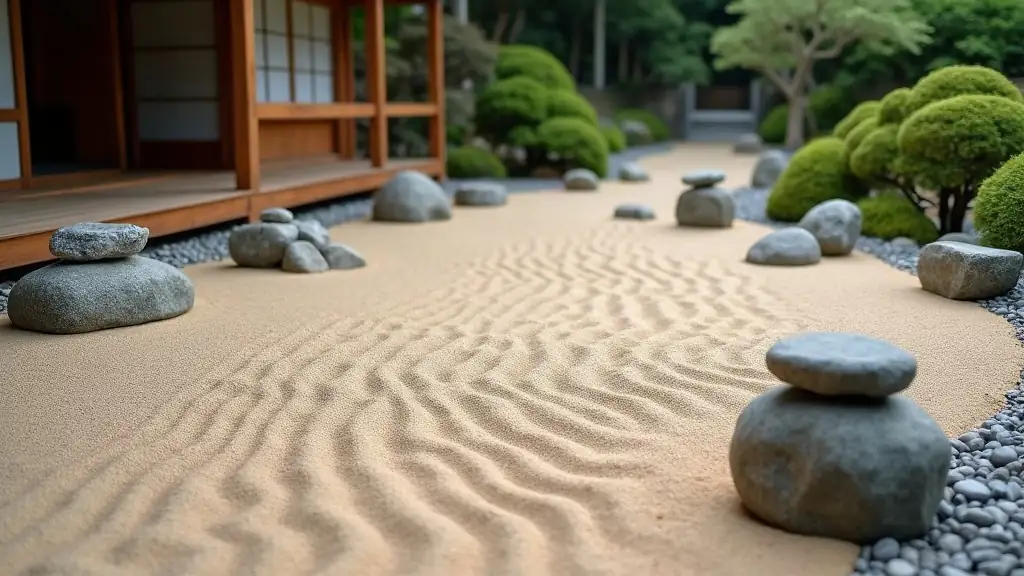
The material list is short. Stones are chosen for shape, grain and weathering, and set so that the most interesting face reads from the viewing side. The ground is crushed granite gravel, pale grey or near white, coarse enough to hold a line when raked. Moss often collars the base of each stone, a soft green joint between rock and gravel. Clipped shrubs or a plain earthen wall close the background.
The best known example is the garden at Ryoan-ji in Kyoto: fifteen stones in five groups, set in a rectangle of gravel against a low ochre wall. It is often said that from any single point on the veranda one stone stays hidden behind another, so you never see all fifteen at once. The garden refuses to resolve into a single tidy picture.
Can you have a zen garden indoors without gravel?
Yes, if you keep the principles and drop the props. What transfers is the logic: one dominant element, a cleared surface around it, a fixed viewpoint, and a plain background. Pick one surface and empty it completely. The rule I use is simple: nothing else within about 12 inches (30 cm) of it, and nothing taller behind it. That radius of nothing is doing the same job as the gravel.
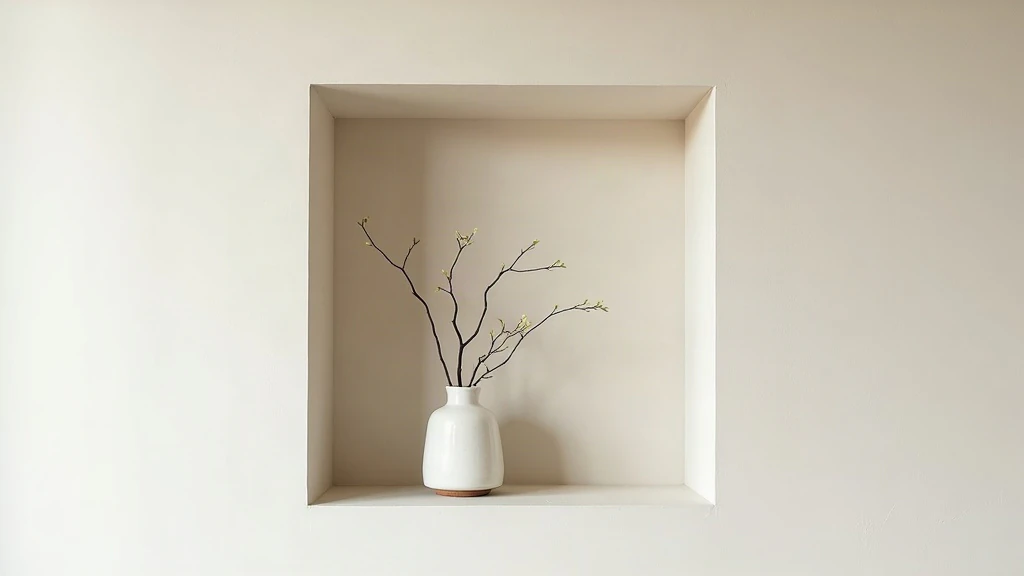
A vase holding one branch is the closest indoor equivalent of the isolated stone. This is the thinking behind ikebana, the Japanese practice of arranged flowers, where stem direction and empty space matter more than the number of blooms. For this I keep a low vintage ikebana vase on the table by the window, because its weight and narrow mouth hold one bare branch upright without any support. In winter I use a single cut stem with no leaves at all.

Keep the background plain. A pale wall, a shōji panel (a sliding screen of translucent paper in a wooden lattice), or a stretch of empty plaster all work. A gallery wall behind the vase cancels the effect.
If the surface sits near a window, the view outside joins the composition. Japanese garden designers call this borrowed scenery, or shakkei: a distant hill, a neighbour's tree, a strip of sky pulled into the frame without owning it.
What the stones in a karesansui garden stand for
Upright stones usually read as mountains or peaks. Low flat stones read as shores, boats or stepping ground. Groups surrounded by gravel read as islands, and two recurring island motifs are the crane and the tortoise, both associated in East Asian tradition with long life. A tall stone set behind two smaller flanking stones is sometimes read as a Buddhist triad.
Stones are grouped in threes, fives and sevens. Even numbers invite the eye to pair things up and balance them, which kills the tension. Three stones of the same height in a row are avoided, and so is any arrangement where two stones sit at equal distance from a third. The weathering and lichen are part of the appeal, which is where wabi-sabi comes in: the taste for the aged, the irregular and the incomplete.
One stone always leads. The others are subordinate, and nothing in the frame is allowed to compete with the lead stone for attention. A room composes the same way. Choose the one thing you want seen first, then let everything else be quieter, lower or further back. Controlled imbalance holds attention far longer than a symmetrical pair of anything.
Sitting low in front of a Japanese dry garden
Temple dry gardens are designed from the veranda, with the viewer sitting on the floor. That single fact explains most of their proportions. Stones are low, walls are low, and the garden is cropped by the eave above and the veranda edge below, like a scroll painting with fixed borders. Standing up changes everything. From standing height you look down onto the gravel, and the stones flatten. Seated, the stones rise against the gravel and overlap each other, which creates distance in a space only a few metres deep.
Indoors, this means low. Seated eye level on the floor is roughly 32 to 38 inches (80 to 95 cm), so a chabudai (a low table) or a shin-height shelf is the right height. A high console puts the composition where you will only ever glance at it sideways. Give yourself a real seat or the corner will stay decorative. I made that mistake first: a beautiful low arrangement and nowhere comfortable to sit, so I never sat. A firm Japanese floor cushion is what fixed it for me, because it holds its loft and keeps my hips above my knees, which is the difference between five minutes and twenty. Place it so you face the composition straight on, not at an angle.

What the empty space of a karesansui garden teaches
The gravel is the most misread part of a dry garden. People treat it as texture. It is not. It is the interval that makes the stones legible. Japanese design calls this ma: the charged gap between things, in a room, a piece of music or a sentence. Emptiness here is not leftover space. It is placed, sized and defended. Shrink it and the composition becomes a pile of objects.
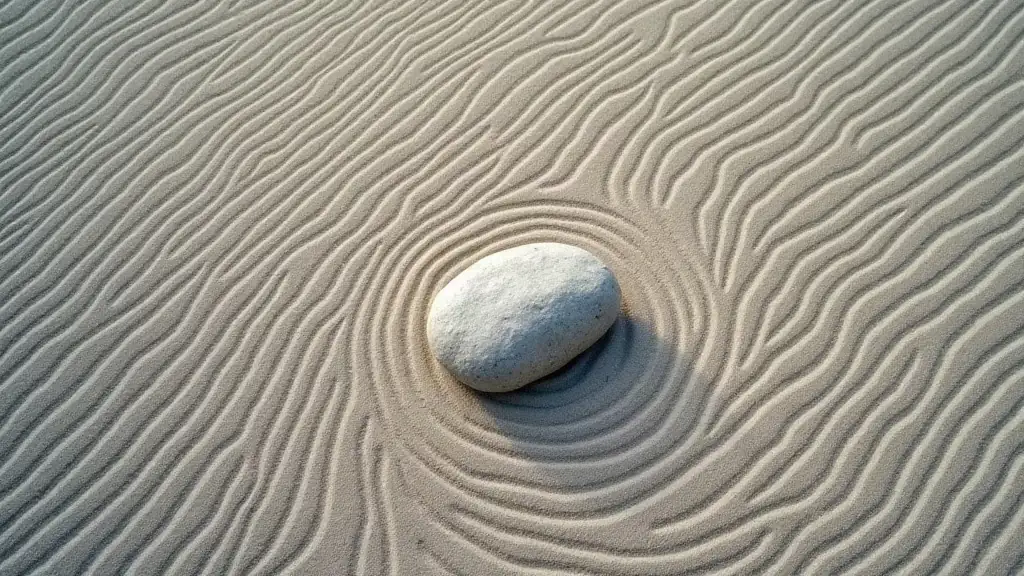
Raked gravel works because it is uniform and empty. Nothing grows in it, and it leads the eye to the stones rather than holding it. Your cleared tabletop or bare stretch of floor does the same job indoors, and a plain woven mat or a single sheet of washi paper under the vase can define that emptiness without filling it. Remove anything that reads as a second focal point: a second vase, a framed photo, a candle cluster, a stack of books. Accept a surface that does nothing. This is the hardest part for most people, including me, and it is the part that actually produces the effect.
How light and shadow shape a stone garden indoors
A dry garden is never the same twice in a day. The stones barely change, but their cast shadows swing across the gravel, lengthen and disappear. Morning raking light makes every stone face read in relief. Flat midday sun from overhead washes the whole thing out. Shadow is the fourth material, after stone, gravel and moss. The shadow is part of the composition, which is why temple gardens are often most striking in late afternoon, when the lines of shade are long and the wall behind glows warm.
Indoors, aim for glow rather than glare. Side light at a low angle gives your branch or stone a cast shadow, which is what you want. A downward ceiling spot flattens the object and throws a hard ring on the table. The lamp I move from room to room for this is a shoji floor lamp, because the paper panels spread the light wide and soft, and standing it slightly behind and to one side of the vase gives a long, quiet shadow. After sunset, keep the corner lit from one source only. Two lamps produce crossing shadows and the relief disappears. Warm bulbs, low output, light coming from below eye level: that is the whole formula.

Karesansui and rock garden questions, answered
These are the questions I am asked most often, usually by people with a small flat and no outdoor space. Short answers, including the ones that deflate a few common assumptions.
What do the rocks in a zen garden represent?
Most often mountains, islands and shorelines, with gravel standing in for water. Upright stones read as peaks, flat stones as shores or boats, grouped stones as islands. Specific readings such as crane and tortoise islands are traditional interpretations, and many gardens carry no fixed documented meaning at all.
Is a zen garden Buddhist or purely decorative?
The form grew up inside Zen Buddhist temple complexes, and the gardens were built as objects of contemplation for the monks who lived there. That religious setting is part of their history. Outside a temple, a dry garden is an aesthetic composition, and treating one as a decorative arrangement is honest rather than disrespectful, as long as you do not claim it is a religious practice.
Do you need sand or gravel to make a zen garden?
Not indoors. Gravel is one way to create organized emptiness around a focal object, and a cleared surface does the same work with no spillage. If you do want gravel, keep it in a shallow tray with a defined edge and expect to rake it after every time it is touched.
How much space does an indoor zen garden need?
Less than you think, as long as the space you give it stays empty. A tray of about 12 by 16 inches (30 by 40 cm), or one shelf, or one side table is enough. What it genuinely needs is a plain background and a clear radius around the object.
How do you maintain a small karesansui garden?
A gravel tray needs raking back into line and occasional sifting for dust. Moss, real moss, needs light and steady humidity and usually struggles in a heated room. A vase with one branch is the low effort version: change the water, and change the branch with the season. If you want to start with the branch rather than the gravel, the shapes in our ikebana vase collection are chosen for exactly this kind of quiet, single stem composition. One vase, one branch, and a surface you leave empty around it.
Explore the Ikebana Vase collection
Browse the ikebana vases if you want to start that quiet corner with one vessel, one branch and nothing else around it.
Browse the collection →