A reader once sent me a photo of her tray: seven stones, a resin bridge, a tea light, a tiny pagoda and a plastic frog, all crowded into a dish the size of a book. She wrote that she had stopped noticing it after a week. That is the usual ending when a tray gets filled. A mini zen garden is a shallow tray version of the Japanese dry garden, or karesansui: fine sand or pale gravel, one to three stones, and a small rake to draw lines between them. Nothing grows in it, and that is the point. The sand reads as water. The stones read as islands. The empty space carries as much weight as the objects. On a desk or a side table, a tray of 8 to 14 inches (20 to 35 cm) is enough, with a single green note set beside it rather than planted in the sand.
Key points
- A tabletop zen garden needs only three things: a shallow tray, fine sand or gravel, and a few stones.
- Odd numbers of stones and plenty of untouched sand keep it calm; crowding the tray is the usual mistake.
- Nothing is planted in the sand. If you want something living, keep it in a separate vase next to the tray.
- Raking takes two or three minutes and is meant to be redone, not preserved.
What is a mini zen garden, and what goes on the tray?
The full-size version is a temple form. A karesansui, literally dry mountain water, is a garden built from gravel, stone and ground, with no pond and often no planting inside the composition. Ryōan-ji in Kyoto is the example most people picture: a rectangle of raked gravel, fifteen stones in five groups, a wall on three sides. The tabletop version borrows the grammar, not the scale. You are not shrinking a temple. You are keeping three elements and a lot of restraint.
The three parts of a mini zen garden: tray, sand, stones
The tray sets the frame. A shallow wooden tray with straight sides works best, because the line of the rim finishes the pattern the way a wall finishes a temple garden. Depth of 1 to 1.5 inches (2.5 to 4 cm) is plenty. Any deeper and the sand looks sunken.
The sand is the surface. You want it fine, dry and pale, in a layer of about 0.6 to 0.8 inches (1.5 to 2 cm). Thinner than that and the rake scrapes the base. Thicker and the grooves slump. For a tray of roughly 10 by 14 inches (25 by 35 cm) at that depth, plan on something like 4 to 6 pounds (2 to 3 kg) of sand.
The stones are the accents. One, three or five, chosen for weight and surface rather than shape. Flat stones sit calm. Upright stones read as a peak. Smooth, dark river stones give the clearest contrast against pale sand, and they stay put when you rake around them.
The rake is the tool, not an element of the composition. A small bamboo rake with three or four teeth, about 4 to 6 inches (10 to 15 cm) wide, handles a desk tray. A wooden kitchen fork or a comb will do the same job if you already have one.
Tray size and depth for a small tabletop
Size follows the surface, not the ambition. A tray that overhangs its table looks precarious, and a tray you have to move every time you use the desk becomes clutter.
One rule holds at every size: the tray should occupy roughly a third of the surface it sits on, never most of it. The bare table around the frame is doing work. That reserved emptiness is negative space (ma), the interval that lets a single object register.
Why nothing is planted in a desktop zen garden
Dry sand and living roots want opposite things. Water the sand and the pattern collapses; keep it dry and the plant fails. A dry garden is also, by definition, a composition without planting inside it. Moss sometimes grows at the base of temple stones, but it arrives there over years in shade and damp, not in a tray on a warm desk. A small moss accent in a separate dish is honest. Moss pressed into silica sand is not.
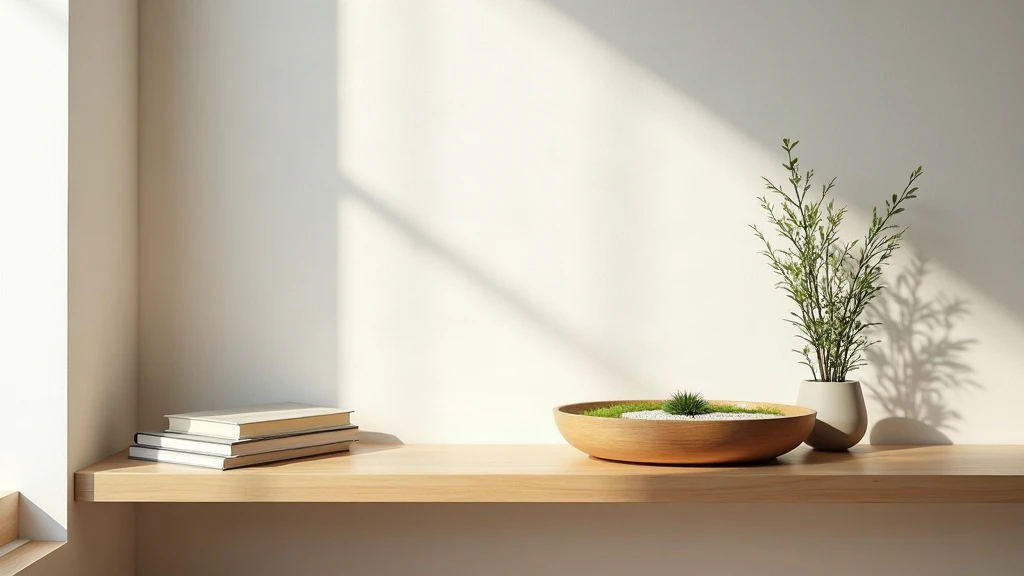
The clean solution is to keep the green note next to the tray. One stem in a small vase says more than a planted tray ever does, and it changes with the season while the sand stays still. The piece I reach for most on my own side table is the Vase Wabi-sabi, because its narrow neck holds a single branch upright without any arranging on my part, and its matte, uneven glaze sits quietly beside pale sand instead of competing with it. That restraint is the whole idea behind wabi-sabi: an irregular surface, one stem, nothing filled in.

If you want to lean into that approach, a tall-necked ikebana vase is built for exactly one or two stems. One flower, cut short in spring. A bare twig in winter. A single hosta leaf in summer. The tray keeps its stillness, and the vase carries the calendar.
Sand, gravel and stones in a tabletop zen garden
Most disappointment with a desk tray comes from the medium, not the design. Some sands take a crisp line and hold it for days. Others blur within an hour, or throw dust across the table every time you rake. Choosing the grain first saves you from buying a second bag later.
Fine sand or crushed gravel: how each one takes a line
Three materials cover almost every tray.
White silica sand is the safest choice for a small tray, because fine, angular grains lock against each other and keep the groove standing. If your tray is large enough to be seen from across the room, crushed gravel at 1 to 3 mm gives a stronger shadow and almost no dust. Avoid anything sold damp, and avoid coloured sand: dyed grains read as craft material rather than ground.
Rinsing and drying sand before the first use removes the powder that otherwise films the table. Spread it on a tray, let it dry fully for a day, then pour. Sand that still feels cool to the touch is not dry.
Choosing one, three or five stones
Odd numbers are the convention in Japanese composition, in gardens as in flower arranging. Three stones give you a relation without symmetry: a main stone, a secondary one, and a small one that links them. Five works on a wide tray. Two stones of similar size tend to look like a pair of eyes, and the eye keeps measuring them against each other.
Vary the size rather than the colour. A useful proportion is one stone about twice the height of the second, and a third roughly half again smaller. Keep the tallest under about 3 inches (7.5 cm) on a desk tray, or it stops being a landscape and starts being an ornament. Matte, unpolished surfaces catch light the way rock does. Polished pebbles look wet, which fights the dry reading of the sand.
Where to set the stones before you rake
Place the stones first, always. Raking around a fixed stone makes the pattern belong to it; dropping a stone onto a finished pattern breaks the lines and leaves a crater.
Keep the main stone off centre. Thirds work well: imagine the tray divided into nine squares, and put the tallest stone where two lines cross, never in the middle square. Press each stone gently into the sand so that a little sand banks against its base. A stone that looks set into the ground reads as bedrock. A stone resting on top reads as a pebble someone dropped.
Group the small stones nearer the main one than to the rim, and leave one side of the tray almost entirely empty. That empty quarter is where the composition breathes. If every corner has something in it, nothing has room to be looked at.
Where to put a desktop zen garden in a small home
A tray of loose sand needs a surface that does not get bumped, and a line of sight that lets you see across it rather than straight down. In a small apartment that usually means a desk corner, a low table, or a shelf at seated eye level. Away from a doorway, away from the edge where a sleeve catches, away from a vent or a fan.
A desk corner, a low table or a shelf
On a desk, the far corner on your non-dominant side keeps the tray out of the working zone while staying in view when you look up. On a low table beside floor cushions, a zabuton seat puts your eye about 16 to 20 inches (40 to 50 cm) above the sand, which is close to the viewing height of a temple veranda. That low angle is the most flattering one for raked sand.
On an open shelf, choose a shelf at or just below seated eye level, and keep the two objects nearest the tray low and plain. A tall silhouette next to a flat tray flattens the tray into a mat. I have made that error with a stack of books, which turned a careful composition into a tabletop detail nobody saw.
How light reveals the lines in the sand
Grooves in sand are not visible because of colour. They are visible because of shadow. Light arriving from above at a steep angle fills both sides of each furrow and erases the pattern. Light arriving low and from one side throws a thin shadow along every ridge, and the whole surface turns into a texture of ripples.
So place the tray where light comes in sideways: near a window with soft daylight, or beside a lamp that sits low rather than overhead. Keep the source to one side, not front on. A lamp I keep moving from room to room for exactly this reason is the Japanese Shoji Lamp, because the washi paper spreads the light into a glow rather than a glare, and its low body puts the beam almost level with the sand. Hard, bare bulbs do the opposite: a bright point reflects off each grain and the lines disappear.
Keeping the surface around the tray empty
Leave a hand's width of bare surface on all sides of the tray, and resist filling it. No coaster, no incense holder, no small figure at the corner. If the tray sits on a desk, that bare margin is also what stops papers from creeping across the sand.
Mugs and water glasses belong on a different part of the table. A ring of condensation on a wooden tray is permanent, and a spill into the sand means replacing the whole layer. Give the tray its own zone and the zone does the protecting.
Raking patterns in a miniature zen garden: lines and circles
The raked patterns have a name of their own in Japanese: samon, sand patterns. On a temple scale they are redrawn by monks on a regular schedule. On a desk tray the whole operation takes two or three minutes, and the technique is simple: hold the rake flat, pull it toward you in one unbroken movement, and do the edges last.

Straight lines, the water pattern of a zen garden
Start at the far edge. Rest the teeth flat on the sand without pressing, then draw the rake toward you at a steady speed. Lift at the end rather than dragging sideways. Place the next pass so its teeth almost touch the previous groove, and keep going until the field is covered.
Parallel straight lines read as still water, a flat expanse around the stones. They are also the hardest pattern to get right on a small tray, because any wobble shows against the rim. If a line goes wrong, smooth that strip with the back of the rake and pull it again. Nobody is grading it.
Circles around a stone, the island pattern
Concentric rings around a stone read as ripples spreading from an island. Work outward: set the teeth close to the stone, rotate the rake around it in one continuous arc, then step each following ring outward by one rake width.
On a tray with three stones, a clear approach is rings around the main stone and straight lines across the open field, with the two patterns meeting in a single soft boundary. Avoid combining more than two patterns. Grids, chevrons and wave shapes each need space to be legible, and a 10 inch tray does not have it.
Finish by running the rake once along the inside of the rim, parallel to each side. That border frames the pattern and cleans up the ends of every line. It is the step most people skip, and it is the one that makes a tray look composed rather than scratched.
How long raking a small tray really takes
Two to three minutes for a desk tray, start to finish. Five if you reposition a stone. That short duration matters, because a ritual you can complete between two tasks is a ritual you will actually keep.
The pattern will not survive. A sleeve, a draught, a cat's tail, and it is gone. That is the usage, not damage. A dry landscape garden is maintained, not preserved, and a tray that gets redrawn twice a week is being used properly. I rake mine when I sit down with a drink in the late afternoon, and I rake it again whenever it looks disturbed.
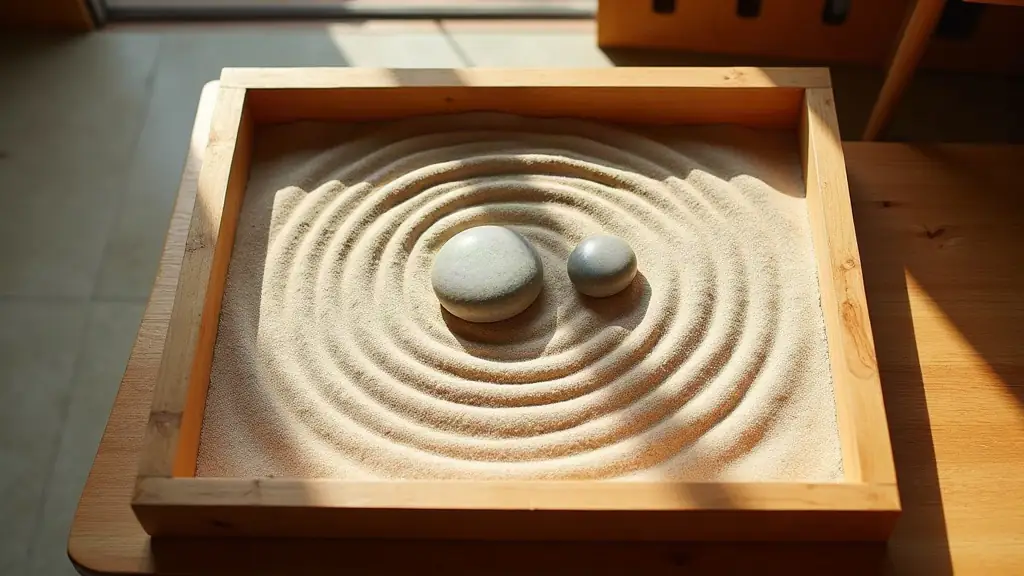
Tabletop zen garden upkeep: dust, sand and curious cats
Sand in an open tray collects household dust, crumbs and hair. It also leaves the tray, slowly and steadily, on sleeves and fingers. Neither problem is large, and both have a two-minute answer. What upkeep really needs is a place in the day where it happens without being scheduled.
Dusting and refreshing the sand in a small tray
Every few weeks, lift out the stones and sift the sand through a fine kitchen strainer over a bowl. Dust, fibres and crumbs stay in the mesh. Pour the sand back and level it with the flat back of the rake.
Wipe the stones with a dry cloth at the same time, and wipe the inside of the tray before the sand returns. Once or twice a year, or whenever the sand looks grey rather than pale, replace the layer entirely. Keep the old sand for a plant pot drainage layer instead of binning it. Never use water inside a wooden tray: a damp cloth on the rim is the limit.
Sand on the table: simple containment
Keep the sand level about 0.4 inches (1 cm) below the rim, so the rake never pushes grains over the edge. Rake toward the centre of the tray rather than toward the rim, and lift the tool rather than sliding it off.
Cats treat fine sand as an invitation. If yours jumps on desks, place the tray where a jump does not land, use coarser gravel instead of fine sand, or cover the tray with a flat wooden lid when you are not in the room. Also keep the tray away from fans and heating vents. A steady stream of air erases a pattern faster than any paw.
A two-minute zen garden habit that sticks
The habit survives when it attaches to something you already do at the same table. Morning coffee. The pause after lunch. The gap before you close the laptop. Sit, rake, stop. No app, no timer, no goal beyond redrawing the lines.
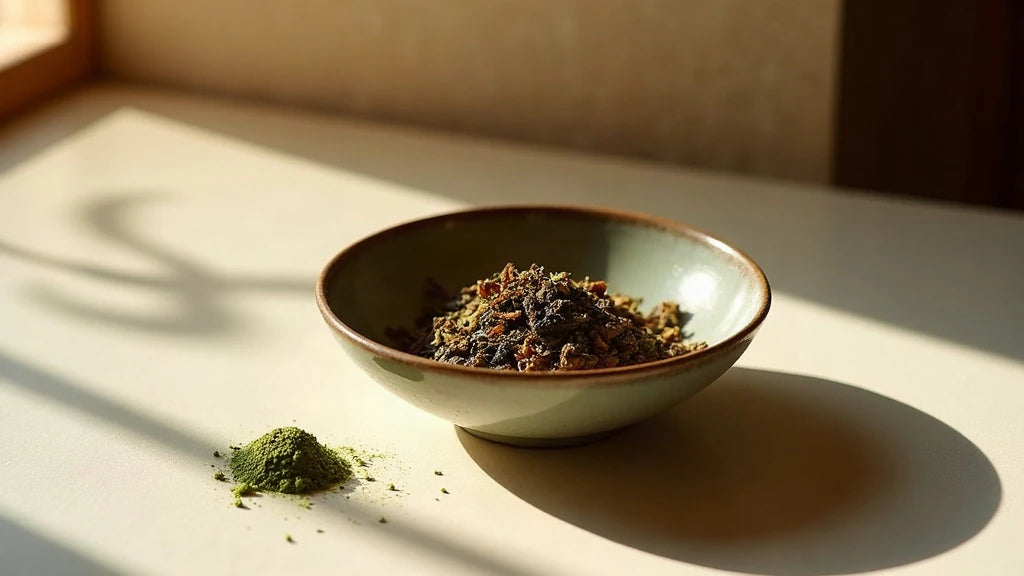
In my own afternoons it pairs with tea. The Japanese Matcha Tea Set is what I bring out for that quarter hour, because whisking matcha takes about the same couple of minutes as raking a tray and asks for the same unhurried hand. The bowl goes on the table, the rake goes back beside the tray, and the pause ends. Two small slow gestures at one table hold better than one ambitious routine.

If tea is not your ritual, anything with a fixed short length works: writing three lines in a notebook, watering a single plant, opening the window for air. The tray is the cue. The gesture is the habit.
Mini zen garden questions people actually ask
These are the questions that come up most often from readers setting up a first tray, with short answers you can act on today.
What kind of sand is used in a mini zen garden?
Fine, dry, pale silica sand around 0.3 to 0.6 mm is the standard choice, because angular grains hold a raked groove instead of rolling back into it. Crushed granite gravel at 1 to 3 mm is the closer match to Kyoto temple gardens and produces wider furrows. Avoid damp play sand, rounded beach sand and anything dyed.
How many stones should a small zen garden have?
One, three or five. Odd numbers avoid symmetry and keep the eye moving, which is why they are the convention in Japanese composition. On a tray under 10 inches (25 cm), a single stone is usually enough; three suits a tray around 10 by 14 inches (25 by 35 cm).
Can you put a real plant in a mini zen garden?
Not in the sand. The watering a plant needs destroys the raked pattern and the dry sand does not support roots, which is also why traditional dry gardens have no planting inside the composition. Keep a living stem in a small vase beside the tray instead, or set a dish of moss next to it and water that separately.
How often should you rake a tabletop zen garden?
Whenever the pattern is disturbed, which in practice means once or twice a week in a quiet room and daily on a busy desk. It takes two or three minutes for a small tray. The pattern is meant to be redone, so there is no need to protect it between rakings.
How big should a desk zen garden tray be?
Between 8 and 14 inches (20 to 35 cm) on the long side for most desks and side tables, with a depth of 1 to 1.5 inches (2.5 to 4 cm) and a sand layer of 0.6 to 0.8 inches (1.5 to 2 cm). Aim for a tray that covers about a third of the surface it sits on. The bare space around it is part of the composition.
If you want that single green note beside your tray, our ikebana vase collection gathers the narrow-necked shapes that hold one stem well. One branch, one stone field, and room left between them.
Explore the Ikebana Vase collection
Browse our ikebana vases if you want one stem beside the sand instead of a plant in it, narrow necks, stoneware finishes and dimensions listed for small surfaces.
Browse the collection →